Climate Change - increasingly horrible disasters loom

...............
there is so much out there about this - I don't really need to provide a lot of sources - a quick google
I think a good orientation to understanding Earth systems is understanding it in a manner similar to human physiology.
Humans have a respiratory system, the Earth has wind circulation. Humans have blood circulation, with gas exchange the Earth has ocean circulation with water evaporating and precipitating. Blood in a surviving human exists in a narrow pH range as does the ocean. The human body is host to a wide variety of bacterial species and the Earth is host to a wide variety of organisms.
Human civilization has arisen in response to an Earth which has remained in a very narrow range of its 4.5 billion year history during the last several million years. Or roughly 0.1% of that history.
Human population has expanded as a result of agricultural infrastructure which is dependent upon the Earth version. Temperature, rainfall and soil moisture levels are all a function of the Earth version.
The global temperature increase is equivalent to a fever and the slowing of the AMOC is equivalent to a stroke with a developing clot in the N Atlantic. The acidification of the oceans is similar to blood acidosis. Looking under the microscope, A version of capitalism which orbits around consumption is like a cancer spreading out of control.
Our situation is just like a college microbiology experiment with bacteria placed in a petri dish and a favorable nutrient. The population expands rapidly until it consumes 100% of the nutrient and then collapses in the toxic byproducts of its own metabolism. The Earth is similar to the environment in that petri dish. The resources are finite.
As a collective, we don't have the power to restrain ourselves. We don't have the ability to agree to live with lower levels of consumption. So .... together we go to our doom.
The Earth does not require biological life to continue orbiting around the Sun. So, it has an identity which is independent of the institution of biological life. Until the Sun reaches a phase where it expands and then the Earth ceases to exist.
Humans can't kill the Earth. But we can kill the version of it which we are dependent upon.
It's hard to imagine a huge and involuntary reduction in population. We've had those kinds of filters in our evolutionary past so there is some precedent for our surviving such events. But the circumstances are certainly different.
We could be creating a new form of digital life which will be competing with the flesh and blood creatures. That life form doesn't need food. It needs metals, plastic, wiring and electricity for robots and calculations. Its needs would be in competition with analog humans.
The Earth does not require biological life to continue orbiting around the Sun. So, it has an identity which is independent of the institution of biological life. Until the Sun reaches a phase where it expands and then the Earth ceases to exist. Humans can't kill the Earth. But we can kill the version of it which we are dependent upon. It's hard to imagine a huge and involuntar
Not sure why we would care. Actually this would be ideal
Apparently, it's genetic thing. Some people care, some don't.
I'm not sure that the people who don't care have a clue about the internal experience of those who do. Since they don't experience that sensation themselves, they have no concept and can easily come to the conclusion that it's all an act.
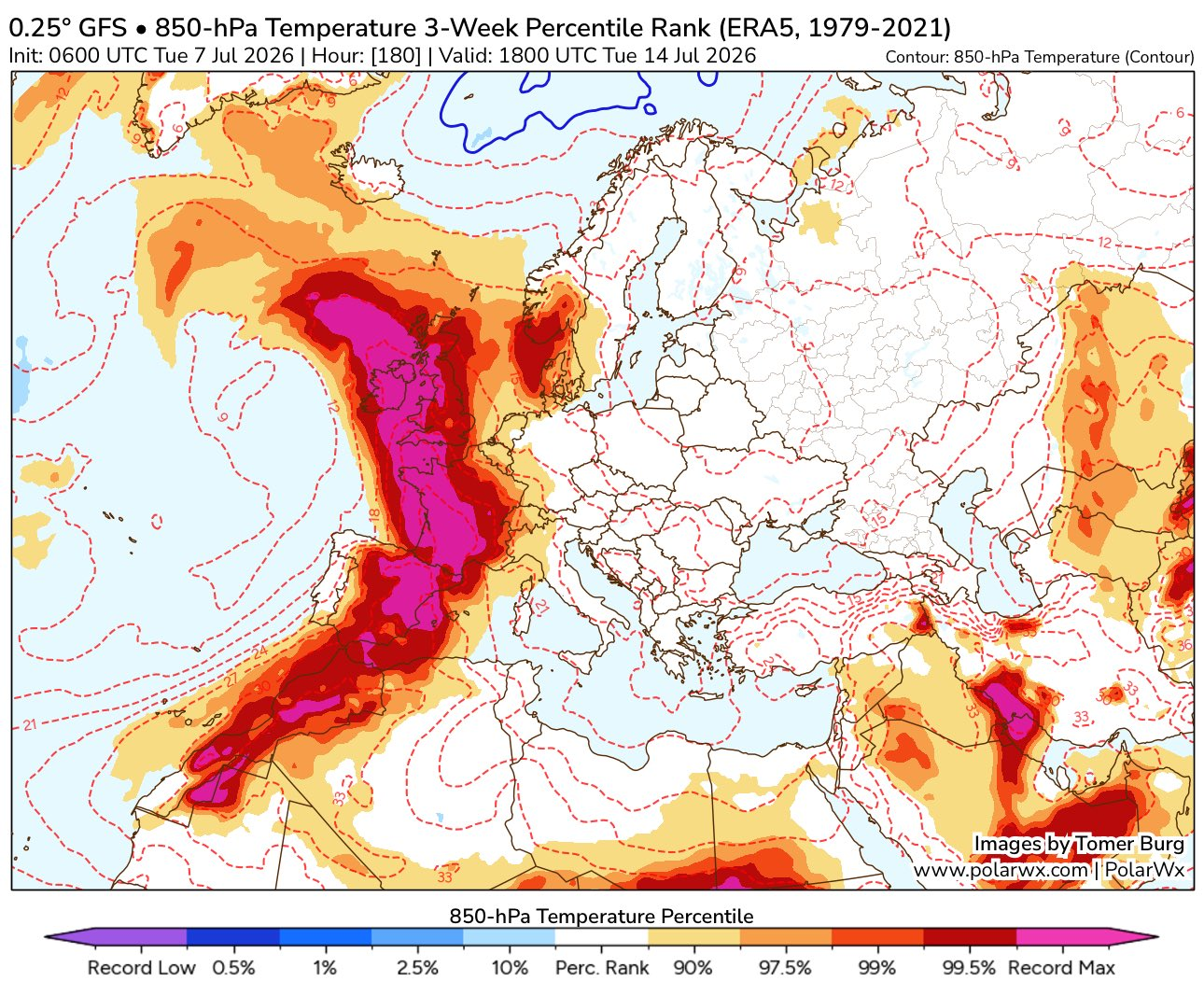
The recent record setting heat wave in France may be outdone in a few days.
Apparently, it's genetic thing. Some people care, some don't.
I'm not sure that the people who don't care have a clue about the internal experience of those who do. Since they don't experience that sensation themselves, they have no concept and can easily come to the conclusion that it's all an act.
Some people are genetically inclined towards murder. Does that mean their genetic inclination gives them justification to murder?
Some people are genetically inclined towards murder. Does that mean their genetic inclination gives them justification to murder?
You're now mixing different concepts. Nature and morality.
I confess that I am animated by some notions of justice. I find climate change to be a textbook example of generational injustice. An injustice which arises to an effective threshold of murder.
So .... I offer an alternative path which allows a us to avoid becoming accessories to mass murder. And people reject it.
Do the rejectors offer justification for their participation in a destructive societal norm ? No.
People are not moral / just creatures. We are survivors and we do whatever we can to enhance our personal position.
It's difficult to make sense of people who are clinging to notions of justice while ignoring environmental destruction.
We are committing young people and future generations to a grim and vicious future.
And we hide from it in cowardice. Because our personal survival instinct tells us not to make waves and challenge the status quo. We shrink from the truth in fear.
When someone dares to tell the truth .... we do our best to silence them. We attack their character.
The truth is taboo.

There has been a paralysis of action because huge oil, gas, and coal businesses would basically go under if proper action were taken.
This is comically delusional and shows a complete lack of first-principles thinking and understanding of the world. Oil, gas and coal are largely irreplaceable with current tech or anything we can come up with in 10 years. It has nothing to do with profits. China's sole goal for example is to have dominance over global industry and become the greatest power; if there were alte
Oil and coal are actually more expensive now than Wind turbines and solar panels. The reason is that wind and sun don't have to be gathered and shipped to the wind turbines and solar panels. Its free. Natural gas is now basically a toss up so running the gas plants costs about the same in some places as the wind turbines and solar panels. But there some states (like Iowa) where it is cheaper to do wind turbines which explains why close to 75% of the electricity produced in Iowa comes from Wind Turbines. And there are some states where natural gas is cheaper than wind turbines in producing electricity.
Here is an article that describes what I...
April 2026
State--------->Wind energy production (MWh)------>Total electricity generation by state (MWh)--->Percentage (%) of electricity generated from wind
Iowa------------->4,856------------------------------------------->6,489------------------------------------------------------------->74.8%
Kansas---------->3,190------------------------------------------->4,959------------------------------------------------------------->64.3%
South Dakota->1,114------------------------------------------->1,768------------------------------------------------------------->63.0%
Oklahoma----->4,350------------------------------------------->7,044------------------------------------------------------------->61.8%
New Mexico--->1,983------------------------------------------->3,966------------------------------------------------------------->50.0%
There are another 5 states between 33% and 45% in the article (also when I tried to use spaces between the above data it didn't work... so --->)
Instead the stalling of shutting down coal, oil, and gas power plants by massively installing wind turbines and solar panels is the way they can continue to make billions of dollars. They don't care about the millions of people dying each year as a result of air pollution any more than Tobacco companies cared about millions of people dying of lung cancer. Its all about money
Huge costs have been placed on industry to clean up air pollution over the decades. Your comment is demonstrably false.
Your comment is demonstrably false.
Here is an article that describes money ...
"The $7 Trillion Subsidy Problem
Fossil fuels benefit from enormous public subsidies that rarely appear on your electricity bill. The International Monetary Fund estimated that global fossil fuel subsidies reached $7 trillion in 2022, equivalent to 7.1 percent of global GDP. That figure jumped $2 trillion from 2020 levels, largely because governments stepped in to cushion consumers from surging energy prices.
These subsidies take two forms. Explicit subsidies are direct government payments or tax breaks that keep fuel prices artificially low. Implicit subsidies are harder to see: they represent the cost of air pollution, climate damage, and health impacts that fossil fuel producers don’t pay for. When someone with asthma visits the emergency room due to coal plant emissions, that cost lands on the healthcare system, not the power company.
The IMF projects these subsidies will rise to $8.2 trillion by 2030 as fuel consumption grows in emerging economies. If fossil fuel prices reflected their true cost to society, the price gap with renewables would be far wider than current LCOE comparisons suggest."
I also think that electric companies are standing in the way in some states because of their prior investments in power plants. Its unclear if the cost of electricity going up (because of the loss of use of power plants) would be acceptable to state governments and that would mean that publicly owned electric companies could go under as well if forced to convert.
The conspiratorial delusion is so incredibly strong. Coal provides the cheapest, easiest energy that exists - particularly if already built. If you mandate a new type of energy then costs soar (particularly hard on the poor). There are numerous countries where this has played out recently, including Germany's disastrous green energy push which hurt both the poor and their industrial base.
Coal and coal plants now costs far more than wind turbines and solar panels. In some states it is cheaper to build wind turbines and run them than it costs to ship coal to already existing coal plants.
Here is an article that describes the co...:
"Natural Gas and Wind Are Cheapest Sources of Power in Majority of U.S.
In a finding that is likely to boost controversy over the future of U.S. energy policy, a comprehensive study of the full levelized cost of energy (LCOE) from various sources of electricity conducted by the University of Texas (UT) at Austin’s Energy Institute found that wind turbines and natural gas combined cycle power plants (CCPPs) provide the least expensive options for new generation across a large majority of U.S. counties.
...
The numbers change somewhat depending on how external costs such as carbon emissions are included. When externalities are considered and assuming an average delivered cost of gas of $5.07/MMBtu, wind was the cheapest option in a plurality of counties—1,347 out of 3,110 in the lower 48 states—most of which were concentrated in the central U.S. (Figure 1). Natural gas CCPPs came in a close second as the cheapest in 1,127 counties, while nuclear was a distant third with 398.
...
Notably, coal-fired generation was not the cheapest option in any county when externalities were considered."
[URL="https://scienceinsights.org/is-renewable-energy-cheaper-than-fossil-fuels/"]Here is another article that compares costs of different types of energy producers:
[/URL]
"Is Renewable Energy Cheaper Than Fossil Fuels?
March 21, 2026
In most places, yes. New solar and wind projects now produce electricity at a lower cost per megawatt-hour than new coal or natural gas plants, even without subsidies. The gap has widened dramatically over the past decade, and the trend shows no sign of reversing. But the full picture includes storage, grid upgrades, and hidden subsidies that shift the math in ways worth understanding.
Direct Cost Comparisons
The most widely cited measure for comparing energy sources is the levelized cost of energy, or LCOE. It captures the total lifetime cost of building and operating a power plant divided by the total energy it produces. Lazard, a financial advisory firm that publishes annual LCOE analyses, released its 2024 update with these unsubsidized ranges per megawatt-hour:
Onshore wind: $27 to $73
Utility-scale solar: $29 to $92
Natural gas (combined cycle): $45 to $108
Coal: $69 to $168
At the low end, the cheapest new wind and solar projects cost roughly 40 to 60 percent less than the cheapest new gas plants, and less than half the cost of coal. Even at the high end of the renewable ranges, solar and wind overlap with or beat the midrange of fossil fuels. These figures reflect unsubsidized costs, meaning they don’t factor in tax credits or government incentives that would push renewable prices even lower.
The ranges exist because costs vary by location. A solar farm in Arizona produces more electricity per panel than one in Michigan. A wind farm on the Great Plains captures stronger, steadier winds than one in the Southeast. Fuel prices, labor markets, and permitting timelines all affect the fossil fuel side. But the core takeaway holds across most geographies: building new renewables is now cheaper than building new fossil fuel plants."
Its also unclear how car companies would fare if electric cars became required. It is likely that the millions of electric cars made in China would prevail because they cost about half of what the cheapest cars made in the US cost.
Electric cars are front loaded with several years of climate damage before they even break even with ICE.
You can cherry pick data all you want but the two years it takes electric cars to break even means that overall the average electric car reduces significant climate damage. And the damage that the production of batteries causes is very much like the damage that coal mining does to areas in and around the places where coal originated. So it is not environmentally damaging in the same way that the smoke coming from coal plants, oil plants, gas plants, and gas powered cars is. That type of damage causes between 6 and 10 million deaths a year.
Here is an article that describes deaths...
"How Many People Die from Air Pollution Each Year?
May 5, 2026
Air pollution kills approximately 8.1 million people worldwide every year, making it the second leading risk factor for death globally, behind only high blood pressure. That figure, from the Health Effects Institute’s 2024 State of Global Air report, reflects deaths linked to both outdoor air pollution (from traffic, industry, and power plants) and household air pollution (from cooking and heating with solid fuels like wood, charcoal, and dung)."
There are no simple solutions. In fact there is no solution for meaningfully reducing CO2 emissions right now. None. The trillions burnt on trying to (for actually negative success globally - renewables made things worse) could have been far better spent on other projects with much higher return for humans or the environment.
You cannot be more wrong. Using Wind Turbines and Solar panels instead of oil and coal plants would save money and greatly reduce CO2 emissions. As would the use of electric cars instead of gas and diesel powered cars. Natural gas plants will continue on and in times of no wind or cloudy days will be crucial to make sure enough electricity is available. As will nuclear plants. But over time the natural gas plants will also ultimately be replaced by wind turbines and solar panels and by new ways of storing electricity (other than just batteries).
Here is an article on Wind Turbines vs N...
"That puts wind in an incredibly competitive position. The report uses an estimate of future natural gas prices that show an extremely gradual rise of about $10/MW-hr out to 2050. But natural gas—on its own, without considering the cost of a plant to burn it for electricity—is already over $20/MW-hr. That means wind sited in the center of the US is already cheaper than fueling a natural gas plant, and wind sited elsewhere is roughly equal."
But the key here is not just about energy. Its about saving lives. Heat increases are now causing hundreds of thousands of deaths each year.
Here is an article on the subject:
"Heat already kills an estimated 489,000 people each year, according to the World Health Organization, but the real toll could be higher because heat-related deaths are so hard to track.
Deaths may be attributed to heart attacks or strokes, with no reference to the fact they happened during a scorching heat wave."
We’re absolutely undercounting in a serious way,” said Bharat Venkat, director of the UCLA Heat Lab."
Here is an article on the future
"Billions could go hungry from global warming by 2100
There is a 90% chance that 3 billion people will have to choose between going hungry and moving their families to milder climes because of climate change within 100 years, says new research.
The study forecasts that temperatures at the close of this century are likely to be above those that crippled food supplies on at least three occasions since 1900."
"The study assumes that on our current emissions path, by 2050, average temperatures will surpass 2.1 degrees C (3.8 F) above those of preindustrial times—the largely agreed-upon limit after which the worst consequences of climate change will kick in. After that, things would get much worse quickly, with temperatures reaching 4.1 degrees C (7.4 F) higher by 2100. Bressler projects that under this scenario, climate change would cause 83 million excess deaths by 2100.
...
Nordhaus’s commonly used DICE model, which Bressler builds on, currently puts the 2020 social cost of carbon at $37 per metric ton. This model suggests that in order to achieve the optimal balance between climate-related damages and the costs of cutting emissions, we should plateau emissions now, and cut gradually starting in 2050. This would result in 3.4 degrees C (6.1 F) of warming by 2100.
But by adding in mortality to the model, Bressler puts the figure at $258 a ton—seven times more. This implies that we must cut emissions in a big way now, and reach full decarbonization by 2050. The result would be only 2.4 degrees of warming by 2100. As a result, by Bressler’s calculation, excess deaths would drop to 9 million by 2100—a saving of 74 million lives. "
An article on greening due to trees liki...:
"Rising carbon dioxide is greening the Earth ‑ but it’s not all good news
Published: April 25, 2016 4:16pm EDT
But don’t get your hopes up. We don’t know how far into the future the greening trend will continue as the CO₂ concentration ultimately peaks while delayed global warming continues for decades after. Regardless, it is clear that the benefits of a greening Earth fall well short compared to the estimated negative impacts of extreme weather events (such as droughts, heat waves, and floods), sea level rise, and ocean acidification.
Humans have shown their capacity to (inadvertently) affect the word’s entire biosphere, it is now time to (advertently) use this knowledge to mitigate climate change and ameliorate its impacts."
And finally this article on climate chan...
'Shweta Narayan, a campaign lead at the Global Climate and Health Alliance, said "many of the regions witnessing the worst air pollution are also places where planet-heating gases are released extensively through the burning of coal, oil and gas. Slashing planet-warming emissions to slow the heating up of the planet can also improve air quality", she said.
Air pollution and climate crisis “are two sides of the same coin", she said.'
It's nice that someone posted anything here with some math and information. I appreciate the time and effort it took to craft an orderly response to such nonsensical garbage.
My critique would involve the following. Emissions are not simply an energy and EV issue. Other issues like diet are a big factor. We're not going to solve anyone without addressing our insatiable consumption demands.
Also .... regarding the following statement.
"The study assumes that on our current emissions path, by 2050, average temperatures will surpass 2.1 degrees C (3.8 F) above those of preindustrial times—the largely agreed-upon limit after which the worst consequences of climate change will kick in.
..... the worst consequences are not subject to agreement. They are determined unilaterally by nature. Estimating only 80 million excess deaths by 2100 likely involves some very generous assumptions which underestimate human brutality. And 2.1C by 2050 is conservative. The current El Nino can push us into the 1.9C - 2.0C range this year. That will prob fall back to about 1.6C when ENSO shifts back to normal. Rising from there at 0.3C - 0.4C per decade gets us closer to 2.5C by 2050.
You're now mixing different concepts. Nature and morality. I confess that I am animated by some notions of justice. I find climate change to be a textbook example of generational injustice. An injustice which arises to an effective threshold of murder. So .... I offer an alternative path which allows a us to avoid becoming accessories to mass murder. And people reject it. Do th
You said “Humans can't kill the Earth. But we can kill the version of it which we are dependent upon.
I said “Not sure why we would care about that” and “it sounds ideal” because the entire concept of trying to preserve a planet that literally doesn’t care about us and has made it possible for trillions of sentient beings to suffer and die doesn’t make much sense to me.
I would take a technological utopia that kills the planet as we know it and only preserves certain aspects of nature that are nice over preserving nature for its own sake. Nature is just an instrumental good.
I agree the effects of climate change are bad, but that doesn’t mean nature is good.
I agree the effects of climate change are bad, but that doesn’t mean nature is good.
Who is making the making the argument that nature is either good or bad?
Nature is what it is. If you believe in a God that created the world, then nature is the world that God created.
Nature is reality whether we like it or not. It's natural law which can't be purchased. Any expression on our part to alter things is an expression of our nature. There isn't anything which is not nature.
My efforts to convince people to cooperate is a manifestation of my nature. It's an impulse which is central to the buddhist lifestyle which gives us to reducing suffering in the world and respect the experience of all sentient beings.
That's obviously not a common orientation. Most people's nature guides them to compete for status with their fellow humans and seek safety through ranking. They have embraced a social system in which their actions are always justified as a result of their being small and irrelevant to civilization wide outcomes. They reject the truth that their actions actually matter and that they are capable of joining together to make a difference. They choose to be weak because they are afraid to be strong. They are like turtles who stay hidden safely under a shell.
If you believe that the survival of human civilization is a good thing, then common human nature in 2026 is not good. I don't consider survival to be either good or bad ..... just something that I struggle for naturally. But it's difficult to rally people without courage.

