suntauri

suntauri
archangelAbout
math magiciansay people overfold vs 4bets, and "gift" you chips in 3bet pots.
do you wanna call and take them post with premiums, and 4bet rather bluffs?
Calling range: the wider you flat (or equivalently, the more aggro villain is postflop), the more incentive to trap.
how's that an equivalence?
anything else?
in reality, say solver fastplays, but we choose to slowplay.
how big will the EV loss be vs specific populations? or can it actually be the best option under certain exploitative conditions?
looks like QQ
Id prob outright jam pre, given his large 3bet and these positions. he's likely getting it in. and we're likely ahead.
there are some considerations regarding his half pot cbet that change things a bit.
on the one hand, your follow up donkshove appears stronger (or maybe not, not clear). on the other hand, he's also likely going to be less willing to let go of his rather strong holding (and that he's strong would mean, what to donk for? chips will get in anyway).
the turndonk is actually more common than it appeared (in solvertheory).
smaller flushes like donking more than larger ones. if spr drops toward your lowish half pot spr, checks seem to be preferred more and more, and donks don't disappear, but get larger (toward allins).
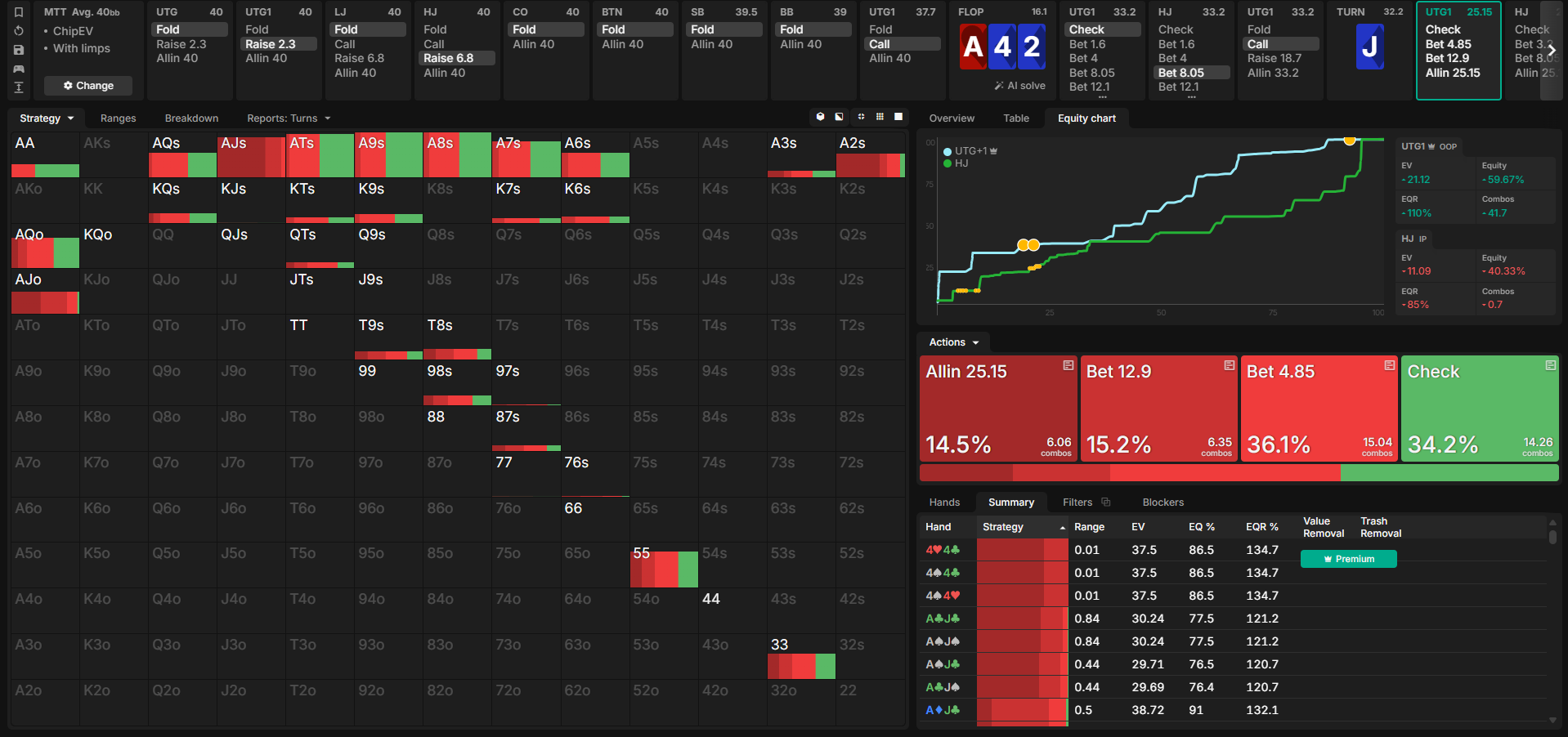
in baseline, he does fold some part of his range of course, but not as high as you imagined.
the chipEV 3x openraise becomes more of a limp or jam in ICM
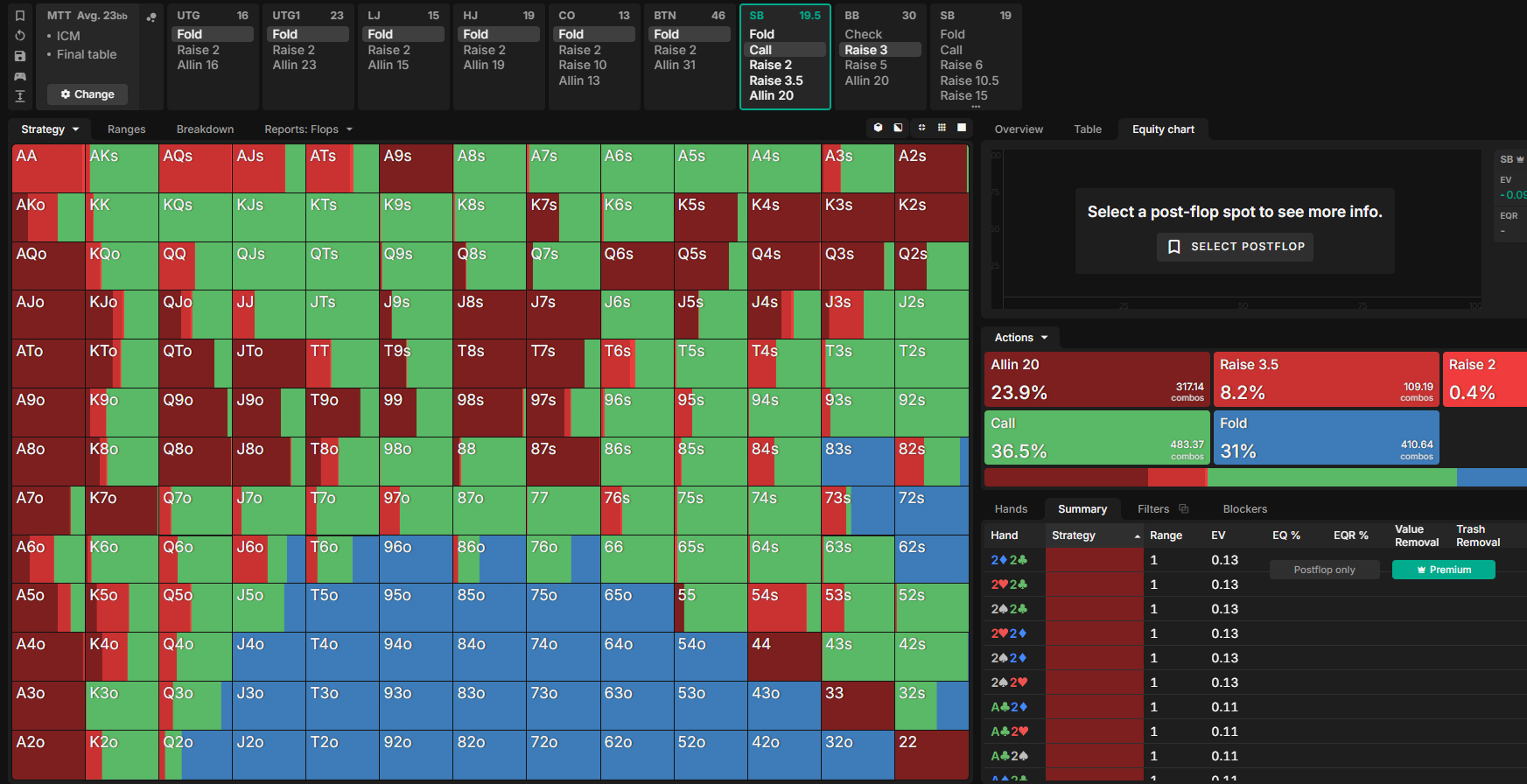
vs a 3x iso a call or jam seem to be okay
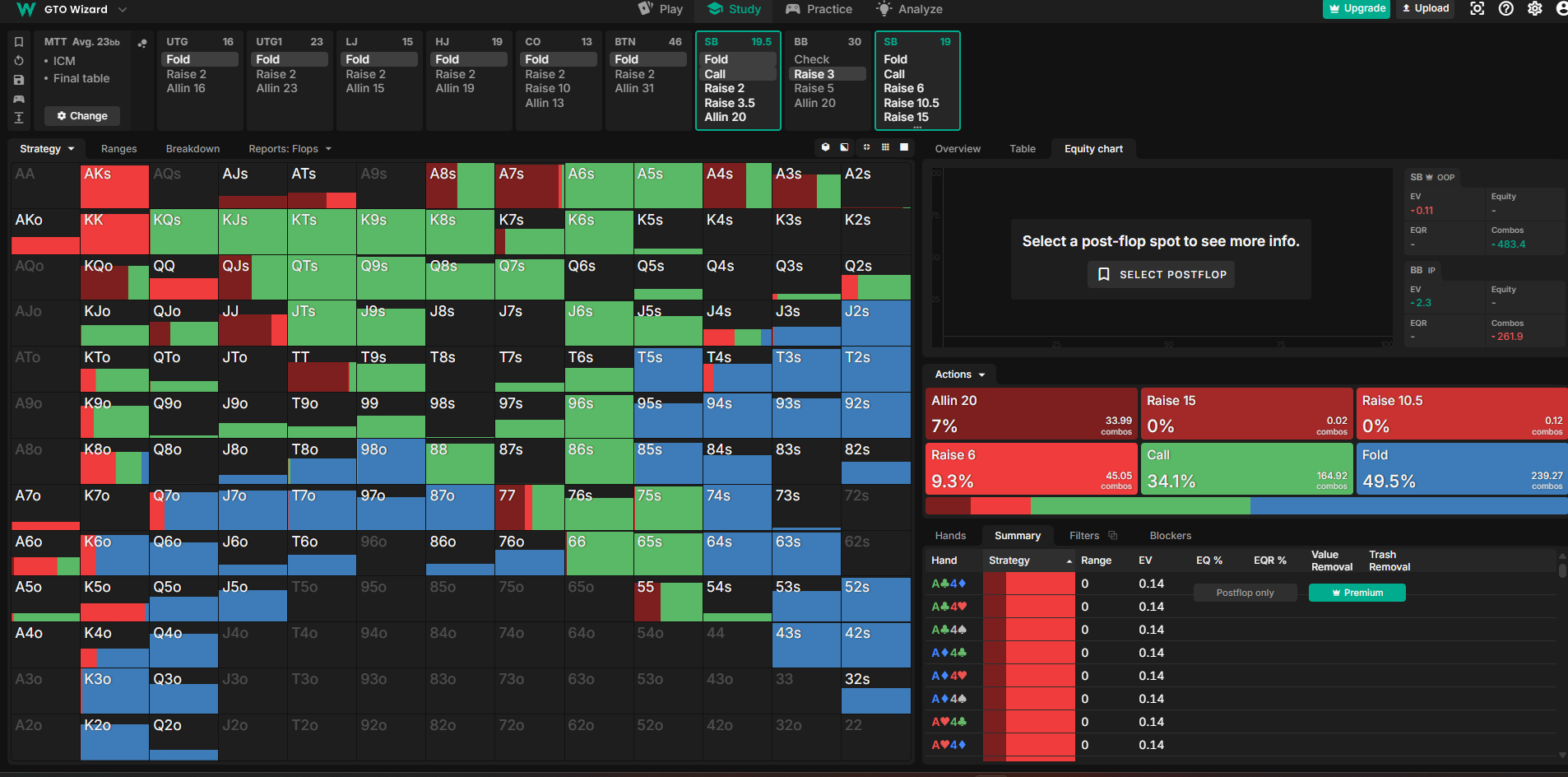
if he makes it larger, like 3.5x or 4x, we'd begin to prefer a reshove more and more.
but if he knows what he's doing, and then he makes it too large relative to the stack sizes, somewhere around 4x - 5x, then it's often strong value that wants to pretend a little bit too hard to be bluffraising in a high pressure ICM spot.
flush? it looks like a ton of things before a flush.
some Jx with a diamond, some broadway gutshot with a diamond that went creative. a pocket. a premium.
creative lines usually go hand in hand with creative hands.
it's a mystery tourney. so often a mystery hand will be revealed. it can be something or nothing.
you have a flush? well now you want him to think that and make him fold. but then you'd want him to call. a funny way to think of it.
with a shove, you'd not be winning anything from some bluffs. you've half pot left, and two streets to go. a flush doesn't want to do anything but check. he'll put more chips in one way or another with many hands.
I can think of one plus jamming something like 87 of diamonds on turn.
he would maybe call KK with a diamond, but not loose more chips if you check and he doesn't improve. or if he begins calling some broadways with a diamond but would be more passive and not bluff them himself, or if he sticks to Jx (with a diamond), or folds some (broadway) overcards with a higher diamond denying realization.
but intuitively that might not be enough for a shove to outweigh a check. many higher flushes will want to check even more.
facing a 3bet with a premium, solver tends to prefer different options across different stack sizes and positions.
sometimes it mixes slowplays with fastplays, sometimes it's purely calling, 4betting or jamming premiums.
what are its incentives to choose one way over another?
in my experience, when someone plays a move like you did, it's so often just something "off" and relatively weak, and not often something one would fear.
hence Id snapcall with any hand you wanted to make him fold.
shoving is good, limpcalling is good, and limpshoving is good.
what's best? that will depend on the situation and incentives.
Id likely limpcall and go postflop.
yeah so besides all that, you did not size down after your checkraise, and then size up again when the fourflush got there.
Like just last night on a similar board I took a line like villain took except I was bluffing and got hero called by an over pair with no flush. So naturally because I turn up with some bluffs I can also value shove like a K or Q high flush and get hero called by worse. I see that runout and think it looks like a great runout to bluff, and because it's a great runout to bluff I
I read that after my post xD
you bluffed on similar paired fourflush board in 3bet pot with similar betsize development? what did you bluff?
I dont think he's sizing up with anything less than a king high flush on river again.
and he probably also doesn't size up with a king high flush.
paired board, 3bet pot, had a flush on turn but went small, then fourflush comes in and he goes big again. gotta be called by something too, which will be a queen high flush or something weaker if he beats it and that seems rather unrealistic.
baseline would call his jam with Q high flushes with EV ~0.1. but he checks almost all his king high flushes there, thus if we make him jam them, Q high flushes would become folds.
so if he's not jamming his king high flushes, but bets them small or checks, we'd only hope for him to have a bluff.
we block his ace of spade bluffs, and would he bluff anything else?
like a pocket (with or without a spade, baseline would bluff the ones without a spade) or a now paired Q8hh backdoor flush flop checkraise? I guess it's often not gonna be a thing.
an ace of spade would call a river jam with EV ~35, so a lot would need to happen for it to become negative.
but if there's no worse value and no bluffs, it may be the case. that we're doing best folding top of our range (solver would only be left with 66 and 88 that are better than our hand).
would he go for a random bluff with that betsize development? hard to imagine. maybe a pocket that he was protecting with and turns into a bluff? the question is how often. as a sidenote, his small turn follow up size is actually the most common used with ~60% frequency.
isnt his betsizing development and checkraise on that runout very indicative of nuts / fh's?
turn he goes so small, we call. on river he sizes up again, obv nuts or fh. hence we fold. effective stack is 100BB.
@tombos
you said it's a biased rounding procedure in your toy game, that's a difference. cancelling may be simply linked to unbiased mixing, or unbiased rounding. dunno if the toy game represents all properties of gto in our game besides that accordingly, or if the complexity is too different, beyond the smaller number of nodes.
@charles
even if someone plays the unbiased mixing strategy, he's exploitable, so your own frequencies do matter, if you want to exploit him. if you only want to stay unexploitable vs him, you may play gto, or any unbiased rounding strategy.
but your own frequencies will still matter, since if you mix biased vs someone who mixes unbiased, you will be probably exploited.
@tombos
a lot of "accidental exploits" don't just lead to cancelling, or approach cancelling.
for example to compare,
limit[sum[(-1/2)^k, {k, 1, n}], n -> infinity] = -1/3 != 0.
yeah I see.
so how come we have condition 3) now? how does the law of large numbers come into play?
imo it's still most likely structural if cancelling occurs, and there's probably a simple proof, based on general characteristica of gto strategies in our game, and the specific unbiased rounding procedure.
if the EV changes for specific hands through unbiased mixing deviations aren't balanced in some way, then it doesn't matter how many decision points or nodes we have. they just wont sum to zero. that's exactly what happens with biased mixing deviations, for example.
This is very suspicious to me. Like, I would have expected mixing errors to somewhat cancel out just due to luck, but not this precisely. The mixing errors cancel out to like ~1/1000th of a big blind. Smaller than I can reliably measure. And the further down I solve my baseline, the smaller the error becomes. What in the F***? Why? How?
as of now, haizemberg might be onto something. checking hard edge cases will clarify more.
I did not intend to be too specific with that, just expanding on the previous thought about where the balancing might occur. we see EVs balancing out, but we don't know yet how.
so I'd try to classify portions of ranges in different ways and see if patterns occur, where EV changes sum to zero.
that's what was suggested before, with value and bluff portions of ranges. Ive no opportunity to see it for myself, so Im bound to guess from afar.
so about biased and unbiased mixing, not sure why it's important here to note that we're not mixing biased, or don't want to mix biased, in the framework of our experiment. it's strategically different for sure, when it comes to exploitability in practice.
but in our theoretical considerations, you're not saying that biased mixing can be exploited by badreg#x, right? assuming same rounding procedure for whole range, not just few hands. same balancing of EVs will occur, and we'll end up with same overall EVs as before, for badreg#biased vs badreg#unbiased, if I interpret everything correctly.
punctuation marks don't transfer from new 2+2 to old 2+2
oh that means that if we change only our mixing splits for a few hands vs badreg#x' strat, we might happen to exploit him?
well I guess most likely something like that will be happening:
say in one specific configuration certain hands gain EV with new mixing splits vs badreg's adapted strat. can you classify them somehow in your strat into a certain category, where solver is mixing similarly, and compare with the rest of the portion where solver also mixes? it gotta balance out somehow after all, so sort of some value vs bluff balancing or so.
what you mean with unbiased mixing? what does biased mixing mean exactly, and why would it lead to different results? I see no difference between biased and unbiased mixing, biased being just an edge case.
have you tried badreg#1 vs badreg#2,
badreg#1 as above,
badreg#2 mixes radically oneway: any mixed action becomes 100% fixed, or some 80% / 20% split.
after changing OOP vs IP to badreg vs badreg, you've posted overall strat vs strat EVs, which stay constant.
can you show EVs of specific hands before and after locking new mixing splits?
edit: just saw your post above. can you keep badreg#1 fixed and only change badreg#2?
(quote) Facing GTO, some hand had the same EV regardless if it bet or checked. Facing bad reg, one of those actions has higher EV. The indifference argument no longer applies.
if you can show that EVs of specific hands stay the same, you've shown experimentally that indifference still applies, and that to exploit badreg#x one needs adjustments beyond mixing frequencies.
looks like a fold.
sure, if he goes small we continue. we can be good and sometimes we also spike a J for good implied odds against all sets and two pairs, and only four combos of straights we'd have reverse implied odds against.
pot looks very strong, up to half pot Id often see them having overpairs or some six.
hmm, it's a question wether a really small cbet is better than a check.
dunno multiway, we benefit from protection, set our price to realize and maybe suck out if they're passive some of the time with sets and two pairs, get value from overpairs and pairs, can count on rare bluffy aggression multiway.
and check? well, we loose less in case they're strong and would raise our cbet, we get to see at least one more street to suck out vs strong hands if they go small on flop and some implied odds, or we fold and save chips vs larger bets or much action.
guess betcheckbet they'll sometimes bluffcatch river even on K and Q overcards which they'll often not going to have.
imo small cbet, not sure though. what's baseline multiway?
dunno, what about betcheckbet with small flop cbet?
if he raises flop, we call and checkcall turn to stack off, except it's someone who rarely bluffs. if he checks behind turn after raising flop, we probably want to go for a bit of value on river.
from a general strategic view at this stage, you can accumulate chips, not pass on good spots.
you'll generate a lot of EV with shoves and proactive plays covering players who are tightening.
call, it's a nice hand. call happy and the flip is yours. if you call in right quantum time you'll have luck. winning flips is a skill.
when would it become a fold in ICM?
we'd have to think of a more extreme situation, final table with shortstack, and covering stack small blind shoving around 100% in baseline, for JTs to become marginal.
realistically small blinds might then be expected to be shoving tighter than that, so JTs would turn into an ICM fold.
but if we devalue ICM a bit and give chips more inherent worth, then it's very often just a cool call.