suntauri

suntauri
archangelAbout
math magicianafter villain's turn check, getting chips in by the river works in baseline by betting two streets only for QJ, which is balanced with many bluffs
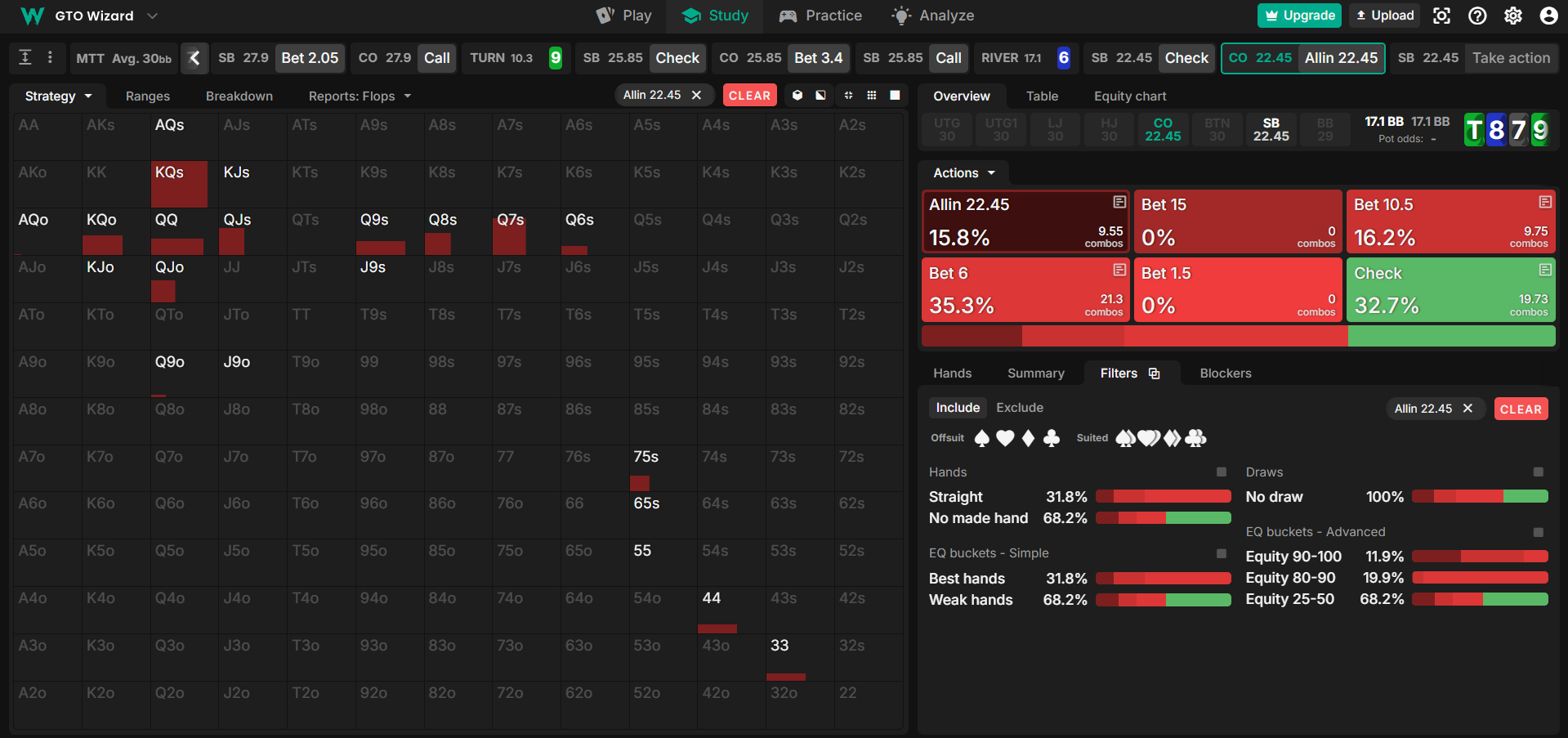
villain defends all his J and QJ and almost nothing else
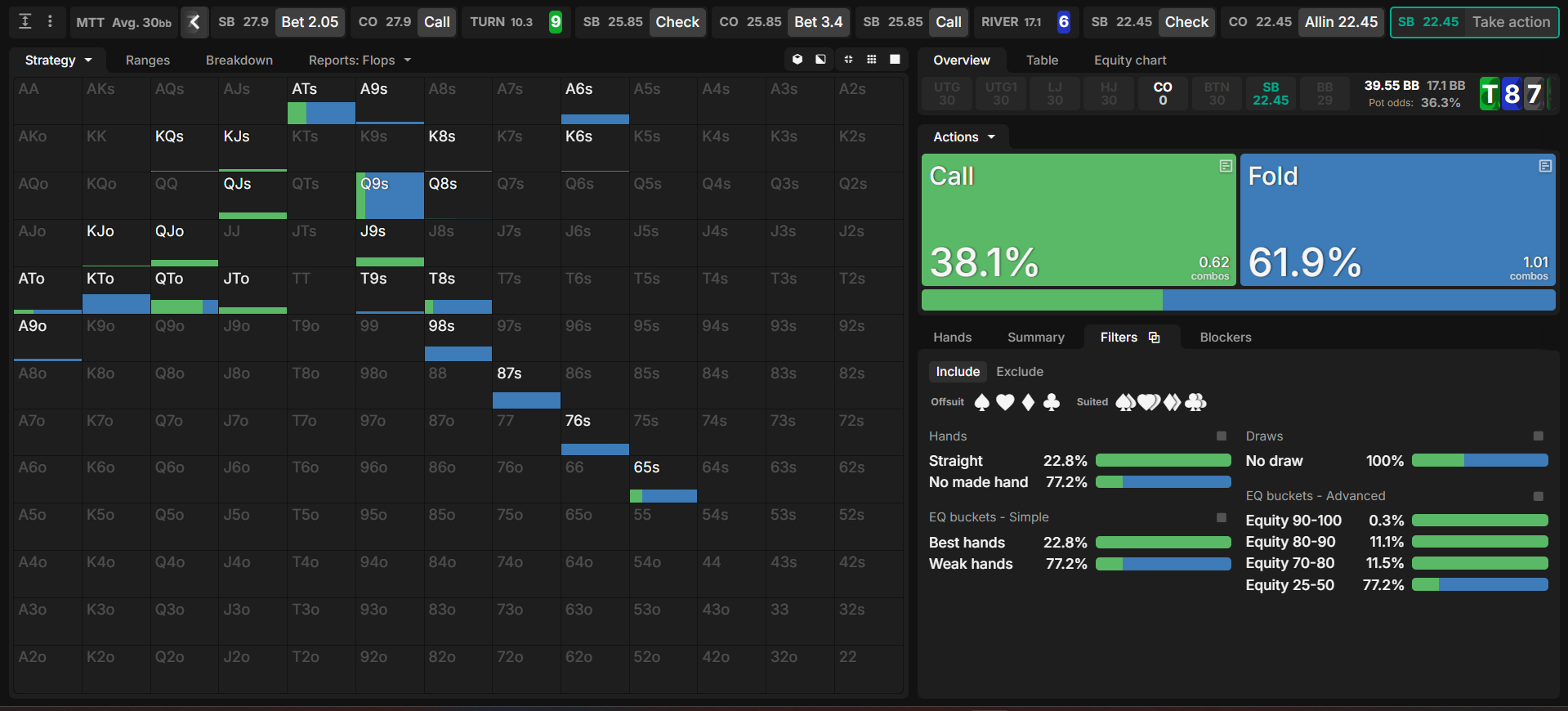
with jacks we'd widen our value range too far
that's a crucial consideration for sure.
it's not a jam that is flying into a capped off 1st and 2nd nuts range - hero will oftenly have J, and I wouldn't be surprised at all to see occasionally some hero have QJ.
I would check a J all night long. Villain may be trying a sneaky checkraise or checkcall with QJ. If I bet J for pot or half pot, what is going to call me? sets and two pairs have some 10% or 20%ish equity vs J (pockets may have been reshoved pre too). If board pairs, we're not going to gift chips to our opponent. If he doesn't improve, he's not going either. maybe he had 9x and will bluff but would fold to our bet now. if a bet flies in by hero on turn, is it ever a bluff in villain's eyes?
don't see a way to get chips in when ahead by betting turn and river with a single J.
I had a look how baseline is here after SB's lead on flop and CO's call.
First villain starts out pretty balanced on turn and checks J and QJ sometimes
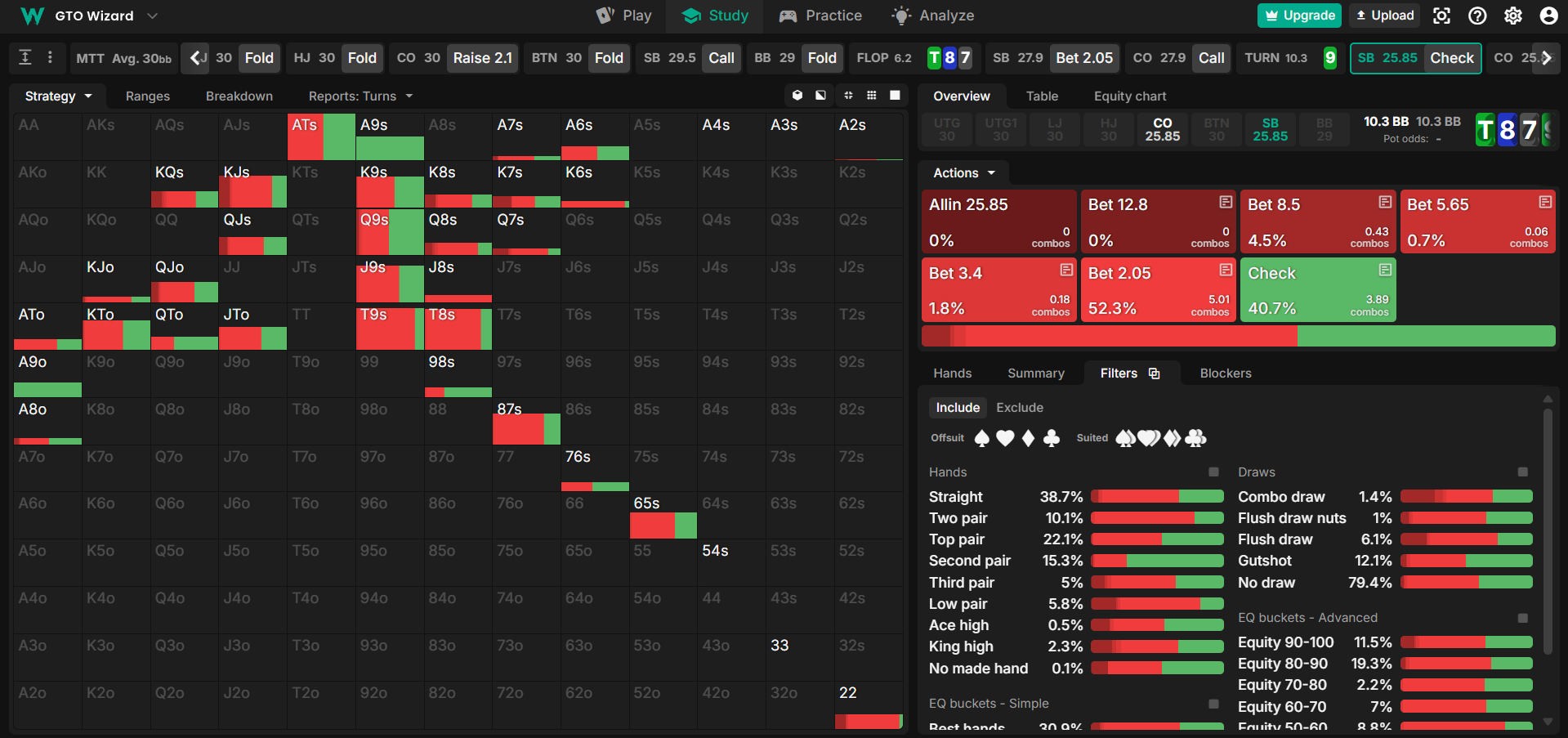
then we also oftenly check a J and sometimes, though more seldom, even QJ
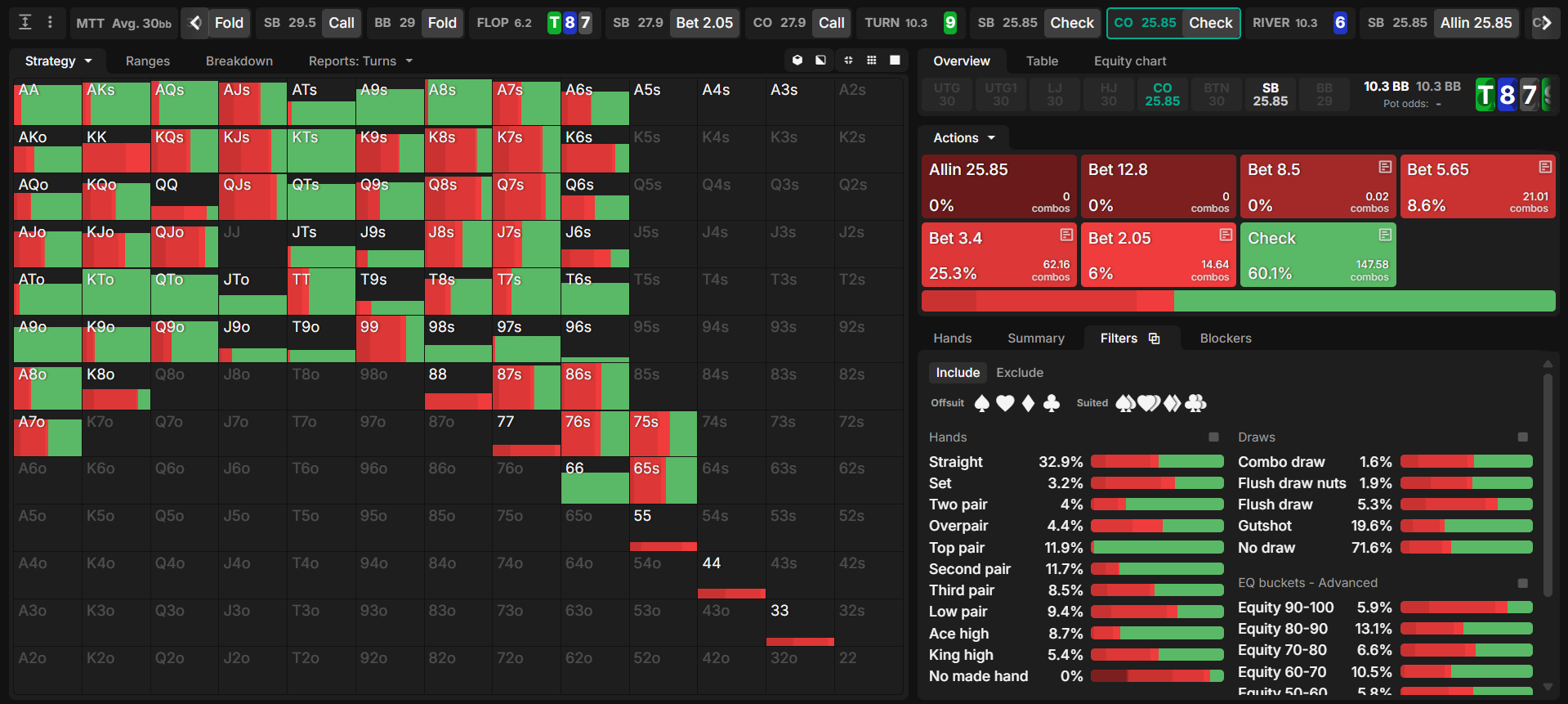
now villain uses two sizings on river, a more bluffy jam that has few J and no QJ, and an 80% pot bet which has more J and most QJ. Sometimes he checks J and QJ one more time.
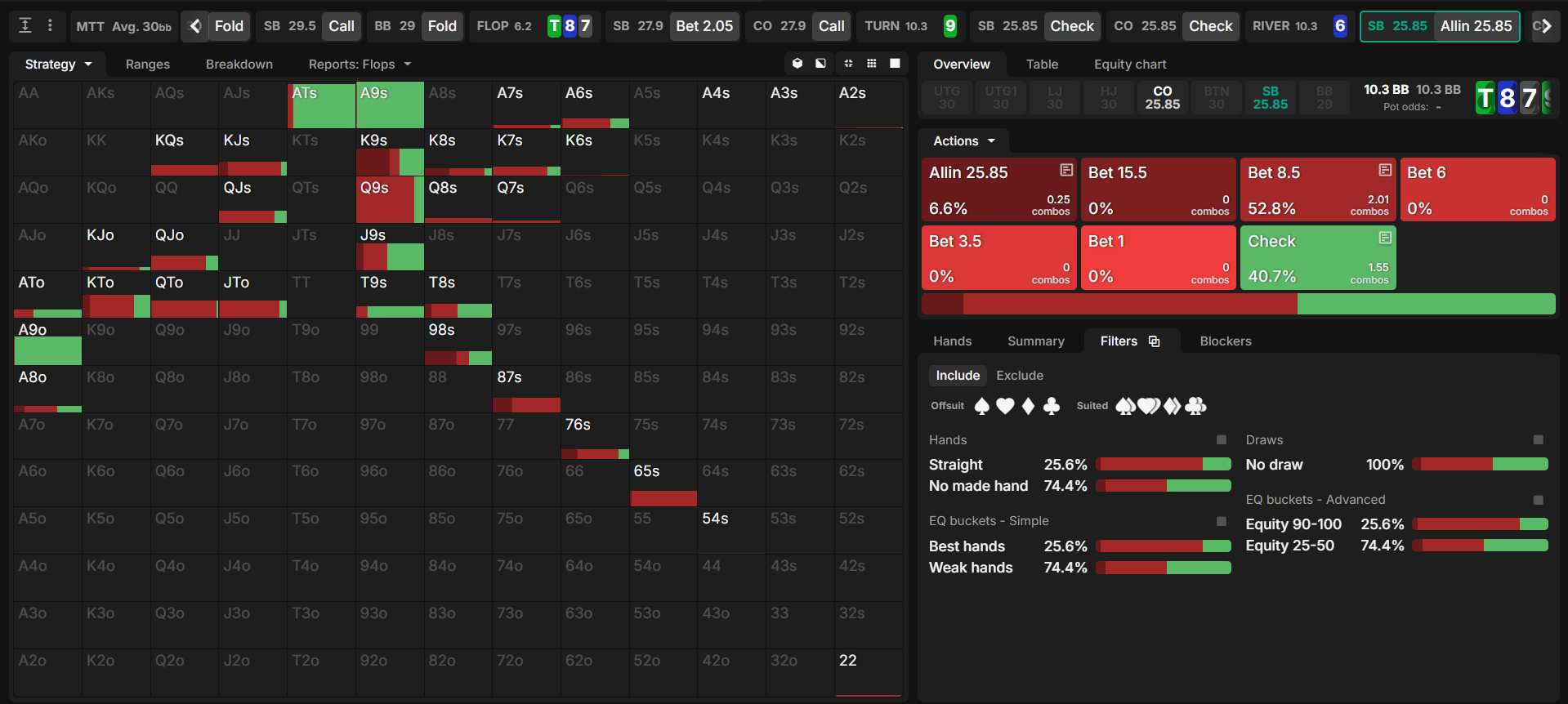
I think it's different in reality, his jam wont be bluffy. In his shoes I'd never jam a bluff, just knowing that someone in this disguising war may have a Joker too often, it feels like harakiri
blocking the effective nuts (if it is something like AAA66 with AA on A66xx) is a bit better.
if they block calls with top set (fullhouse), they may go for smallish sizing too to make it more bitey
overall, shouldn't happen too often though
he has many standard calls with the 7s that he sometimes turns into bluffs
{ A7ss, 67ss, 78ss, ...}
I don't think he can call too much hoping for profitable bluffing spots that may arise exloitatively beyond baseline.
Here hero creates an exploitative situation for villain to abuse by his river sizing (and for hero to potentially reabuse as said eggs. but that would require an exact plan beforehand on how to react, and belief in villain going for bluffy exploitative aggression too).
but villain can't expect hero to create that spot beforehand. if he tries to call to bluff too much, he may run himself into counterexploitation:
for example, if hero plays his aces on river by always checking them, and villain ends up with a bunch missed draws that he then fires to be snapped off. it's not as easy as it may seem.
In baseline he sometimes bluffs hero's third riverbarrel with hands that block fullhouses, so Ax or 6x, and more seldom missed straight and flushdraws. generally the frequency is pretty low.
By your remarks on population dynamics I understand it that way (assuming some larger normalish riverbet by hero):
villains' raises will be underbluffed, thus heros will overfold
knowing this, one can profitably exploit this population dynamic himself as villain: bluffraise more on river, and heros will overfold
some villains may be exploiting this population dynamic - especially after such a smallish riverbet. So if we believe villain may be doing it, we can counterexploit by overcalling.
first hand
also an important consideration,
if villain tried to bluff hero on turn and hasn't been succesful to fold out hero's hand (ace+), why would he assume to be able to achieve it on river when things changed for the worse:
he still has all his (potential) bluffs,
all missed,
and with another 6 on river his 6x combos went in half
first hand
just 55 isnt enough, it's 3 combos vs 20-25 combos of 6x.
for hero to call him off on river, villain does need more semibluffs he raised on turn - but would he raise any of them? at least 10 more semibluff combos are needed.
second hand
why is it telegraphing not having a jack?
maybe betting jack is best play for hero (is it?), I feel like it's not obvious so villain may have reason to assume hero may easily misplay (if it is a misplay) his jack by checking it, so hero may still have jacks in his eyes.
if it was telegraphing not having a jack, maybe it would be worth it?
on the other hand,
it's perfectly reasonable for him to sit there with QJ on river and be like "oh, perfect chance to make it look bluffy" and jam targeting your whole range.
maybe sometimes he does think that you're much less likely to have QJ there since you did not bet turn, then he might jam his J striving for
1) you could bluffcatch with nothing
2) you could fold a J and he gets you off a split,
both are nice results, when in
3) you only call with a J,
he doesn't loose anything (as long as it's not QJ which he thinks as unlikely).
So I think, he's on a J or QJ
second hand
I don't think he's bluffing since he'll risk a lot to push you out when you'll call with a J or QJ.
He may not even achieve his goal and sometimes risk all these chips for a split, so high risk low reward if you bluffcatch and dont believe.
on turn you can have a lot of QJ and play it deceivingly to get max value from a J on river.
A J may also not always want to bet since villain may not really cap himself with his turncheck.
Straights may not want to play this board too face up, whether villain or hero.
balancing not loosing too much when behind, with winning more when ahead
I dont think there's much bluffing by villain here, whether fives or draws, in all cases:
hero vs villain: 1) rec vs rec 2) rec vs reg 3) reg vs rec 4) reg vs reg
since we somewhat reasoned ourselves to fold an ace, and BB appears to have many sixes, perhaps he gets to bluff more than we presumed?
1) to 3) are pretty clear and covered above, closest imaginable case is 4) reg vs reg.
I doubt reg villain's gameplan on turn having around 50 combos of sixes and 50+ combos of bluffs (78, 79, 89, flushdraws, ...) will be to barrel out hero's most likely holding, an ace, by checkraising turn and barrelling pot on river when hero will get odds to call with any bluffcatcher. reg villain would be up against a still uncapped range and subject to high reverse implied odds if he hits his draw.
having 555, being sucked out on with the third six on river, it's the only case where he may consider going for a bluff (if they ended up there and reg hero didn't fold on turn to checkraise), since reg hero wont put him on any missed draws but a six and six only - or three combos of 555, which are far too few.
for fives 555 he can have 3 combos and even on river, when there is just one six left, he can have 20-25 combos of 6x.
as long as he did not bluffraise anything else on turn, he may bluff his fives 100% of time and we'll still let go of our ace
first hand
BB isn't checkraising an ace on turn threeway when it's so obvious you're having (at least) one (potentially strong) ace as UTG, so we're not calling for a split on river.
on the other hand, it's fairly reasonable for him to sit there with a very strong holding on turn and check it, thinking an ace will bet anyway so he'll get to checkraise for more value.
his turnvalue is {6x, 555}
with the third 6 on river we sucked out on 555 which he may turn into a bluff now.
if he for some reason raised some bluff or draw on turn (very unlikely), it's so obvious at latest on river that he'll be up against an ace that no one will try to bluff us off sixes full of aces as pretty much the second nuts pre quad sixes. [on top, we kind of sometimes may also have aces full, 6x, 555]
as BB, even though just one six is left in the deck, he can still have many 6x combos, suited and offsuit.
since he's not bluffing he's beating us with quad 6666 like always and hence we like a fold.
if you wanted to make a case for jamming queens,
instead of lining out what is the opposite in above solution:
the 4bettor does have 4betfolds and 4betcalls beyond AA and KK,
you may have leaned on something like
"that massive 4betsizing is often AK"
or
"the 3bettor may join the party with JJ" and so on
we're indifferent between jamming and folding QQ
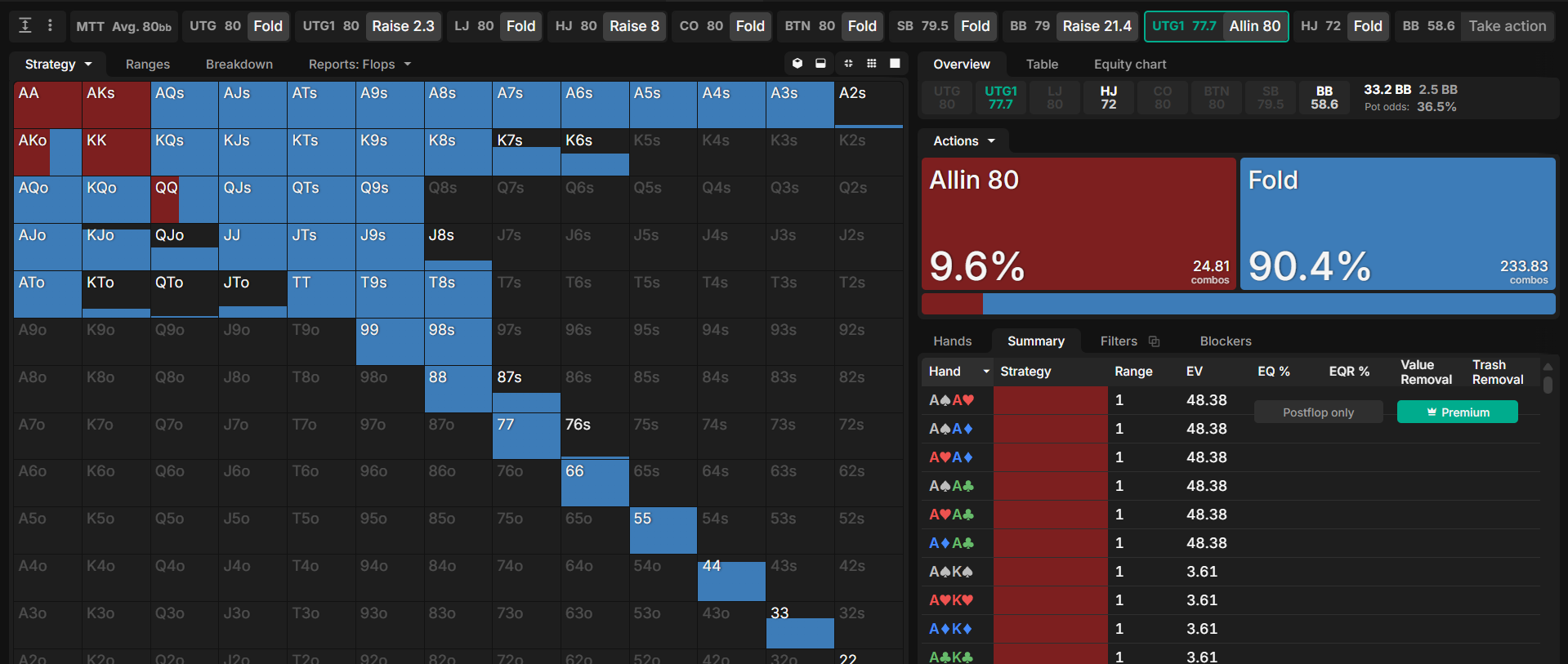
when MP has as many 3betfolds as below (even though he appears to have 3betcalled AQ, I still think he's 3betting less and ofc wouldn't call our jam)
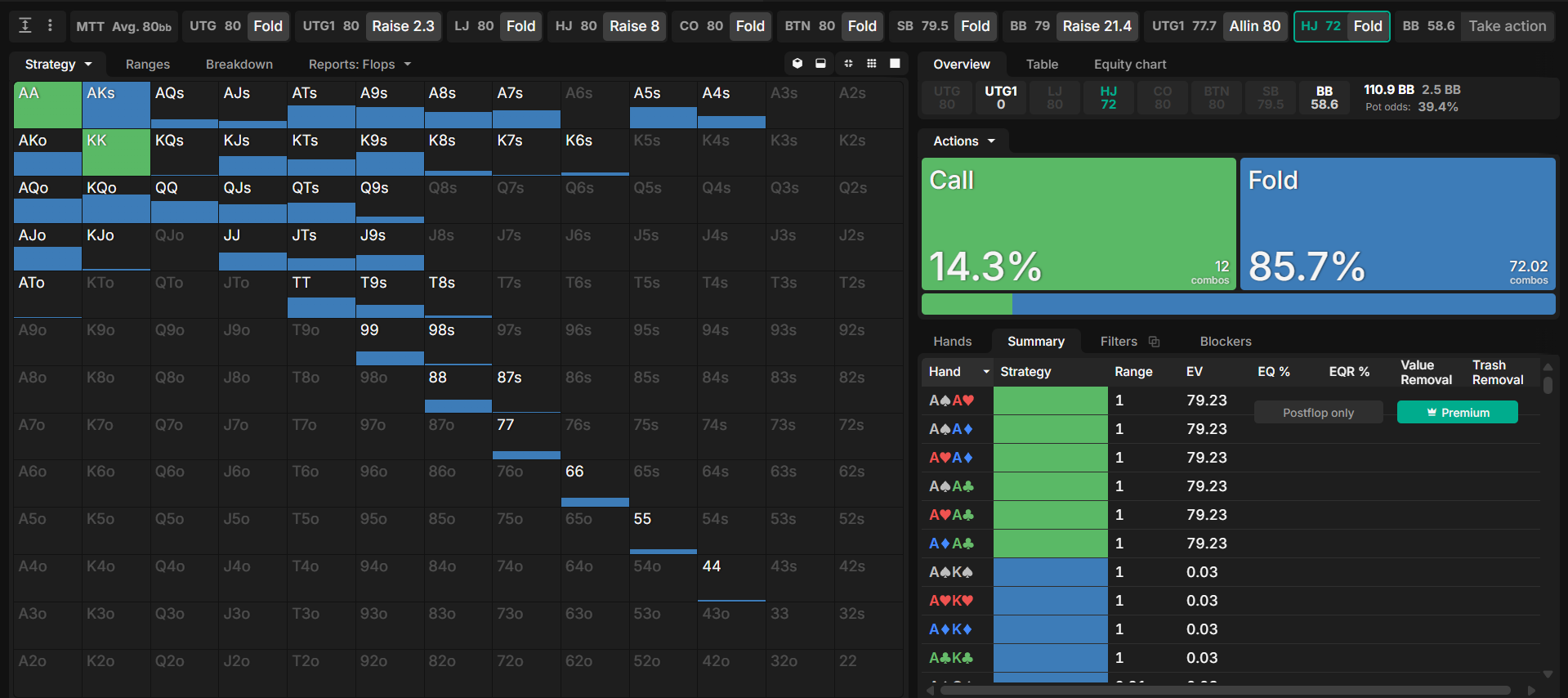
aaand, much more crucial, when BB has as many 4betfolds as below (which he's not going to have) and 4betcalls like JJ and TT that we dominate, but I doubt he's going to 4bet TT.
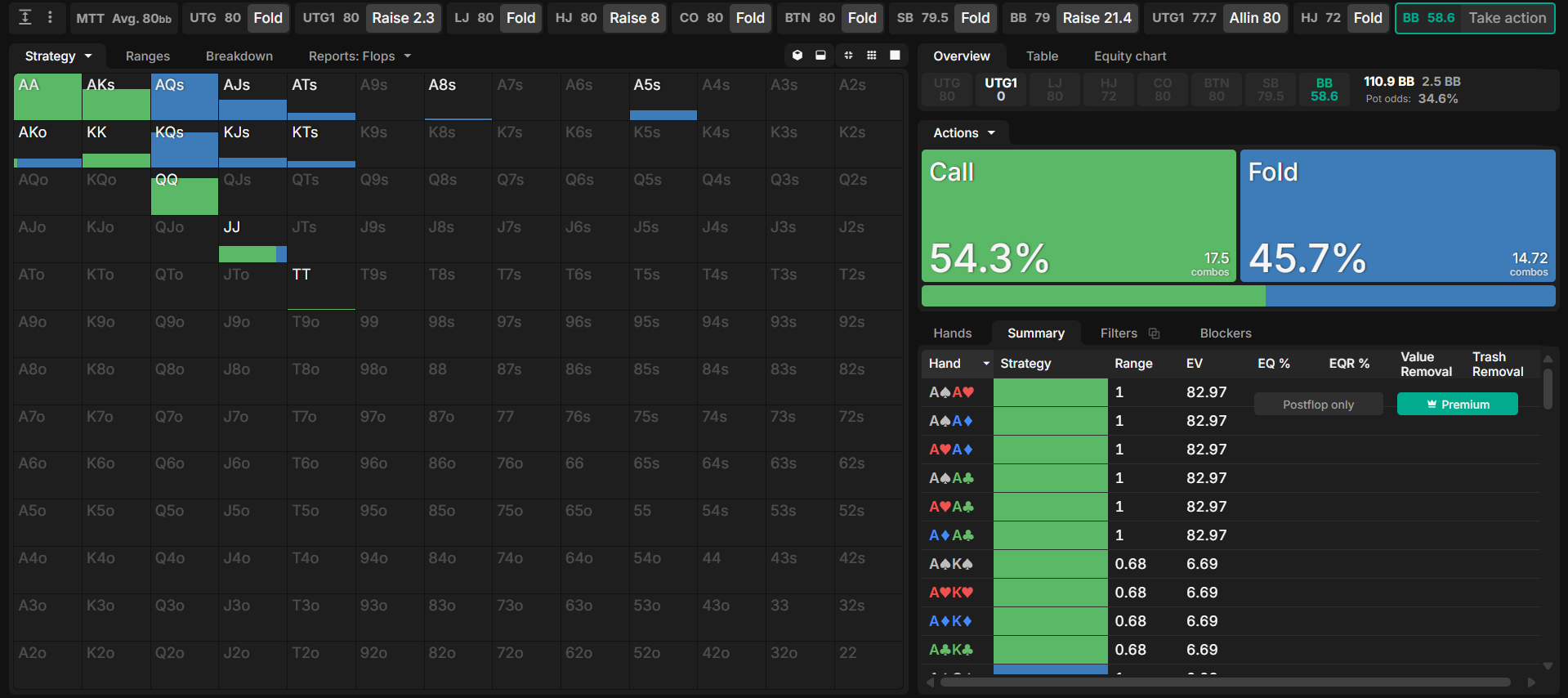
hence it becomes a clear fold in a more general situation - add on top of that BB's massive 4betsizing and it's even more so.
good fold.
you can go with AA and KK and I think AKs is also ok.
most decisions have advantages and drawbacks related to outcomes and actions on subsequent streets across different parts of your ranges (draws, value, air, ...).
positives for calling two pair in villain's shoes without pure balancing considerations:
you allow your opponent to barrel off bluffs like KQ that simply miss in most cases
you make sure you dont isolate yourself vs potentially only stronger two pairs or sets or high equity draws
you may represent missed draws on river yourself and be paid by bluffcatchers
you may even get away and save chips on really bad runouts
you may think about folding if both opponents show significant strength
and so on ...
nothing absurd. that's a bunch of thoughts that may be floating through opponents' minds at any time and subsequently lead to them playing their hand carefully if they're not feeling like going full throttle.
a) In general, I wouldn't rely on anyone in the entire world to unwaveringly follow one strategy, even if engraved in one's mind, because of ever-changing conditions (which may call for intentional adjustments) and disruptive factors as shifting affective states or unpredictable thoughts (which may unconsciously lead to adjustments).
b) we can think of our opponent as an average through all possible opp's (of certain kind) in field to account for the fallibility of the profile that we generate of him out of a finite and incomplete sample of reads and plays. the field as a whole will have unpredictable randomness of nonzero degree in any situation.
c) how capable is our opponent, what strategy is he going to play...
1) vs fish
2) vs topreg
3) vs unknown opponent?
the aforementioned idealized ABC strategy leaves him open to severe counterexploitation.
is he capable to play in the most optimal way vs us and not be outplayed? if we're sure about him fastplaying his strong value and passively playing his draws, we're able to take full advantage of it.
@b'eyelash
I contemplated "competent ABC poker player" now,
yeah guess he'll check behind scary flushboard on river with nonflush value holdings.
Would ABC players call flop threeway with QJoff (with a heart)? And then also call turn when QJoff became a double gutshot?
If they'd somehow arrive on river with QJoff, they prob wouldn't bluff though, right?
Well if he's ABC of that kind, then it's a clear fold. As you said, he may even fold A6s on turn,
and for hero river is a clear check too for the reason of same characteristics of (extreme) ABC opponents
either villain is competent or he doesn't have ace rags. you can't have both.
Hero's river check isn't strong at all, his strong holdings, that don't have to be flushes, will win a lot more by outright jamming themselves and being bluffcaught or called by worse value.
He will so often be capped toward weaker Ax pairs and Tx pairs.
A fair question is what villain will think about how often these hands will pay him off.
one consideration is that villain may simply think that hero is always weaker since he capped himself with his check and thus try to go for value no matter what.
in that regard, a consideration that carries far more weight is if villain can have empty hands that turn into bluffs on the river.
natural ones that come to mind would be QJ and J9s that were a double gutshot and openender on turn.
we dont know if our live opponent would continue with them against our big sizing.
I had a look in wizard and the solve surely does, even against a large overbet. It folds gutshots like KJoff and KQoff though, and continues with all Kx and Qx flushdraws (what our opponent might also not do).
If we check river it does turn QJ and J9s always into a bluff no matter if one card is a heart or not. Blocking flushes wont matter since we'll never check a flush. With the bluff it tries to make us always fold king highs, Tx, JJ ... and at a low frequency Ax.
Only QJ are 15 combos already (without the flush QJhh).
He doesn't need to end up with them as often as solver does on the river and bluff them what he'd likely do to increase the profitability of a rivercall in any of the scenarios above
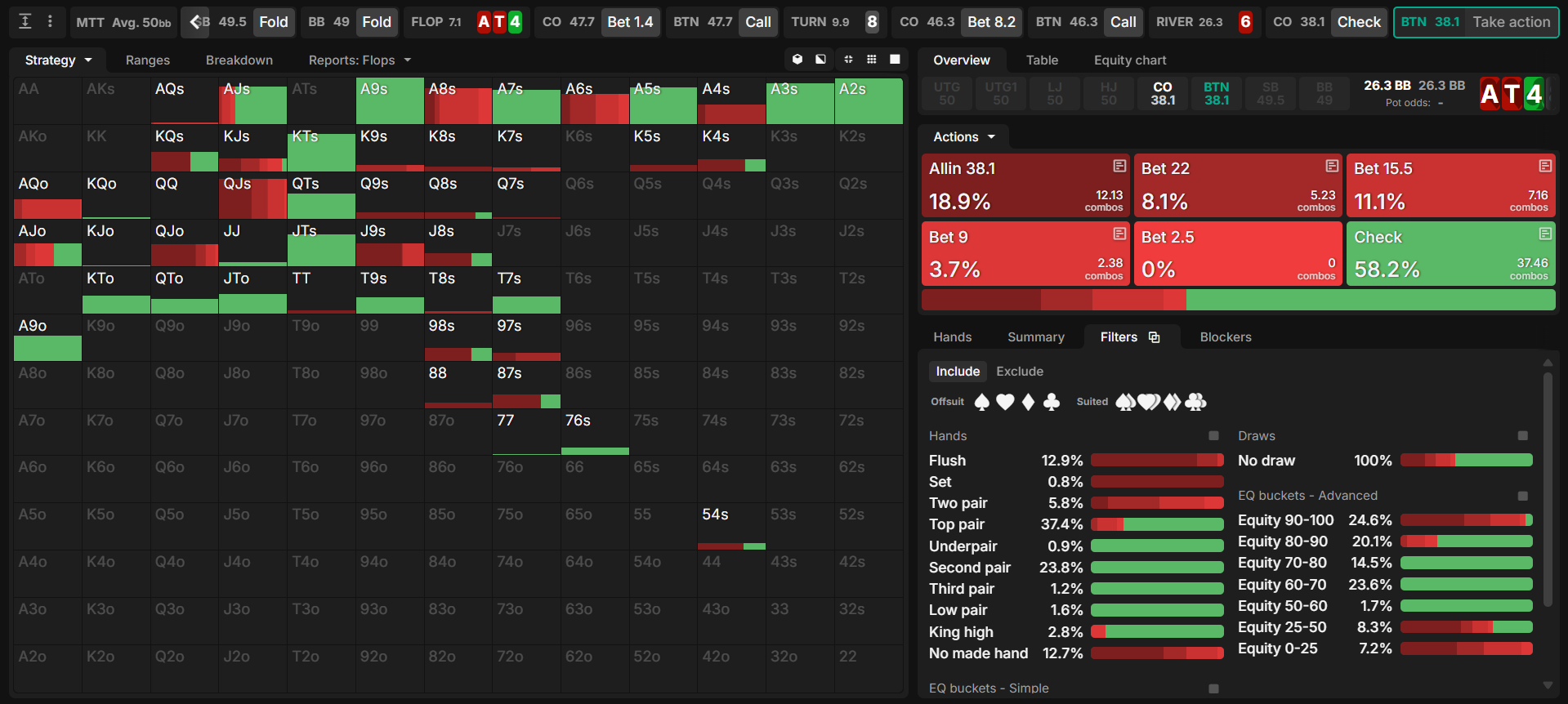
(the solve is headsup, not threeway, what could somewhat alter things a bit, considering it uses a smaller flop cbet sizing too. I guess J9s wont continue on flop through a call at all, and QJ maybe only continues with a heart, Ive no idea though about how it would really look threeway vs half pot cbet)
the above doesn't factor in any intuition, live reads and 6th sense perceptions of course
we can change the variables a bit and check if it will make us lean more toward a fold:
if he plays his pair+draws and combodraws passively and rarely raises them earlier,
we can give him 12 combos at 80% frequency -> 10 combos
if he always raises his stronger two pairs and sets on flop or turn,
he will only have A6s on the river: 3 combos at 100% frequency -> 3 combos
after your river check he'll still see your range as rather weak overall and may go for value with A6s at 66% frequency -> 2 combos
so we're winning against 2 combos and loosing against 10 combos of his river jam which gives us
16% equity < required 33% equity
here, if we were winning against 5 or more combos, our equity would be sufficient for a call
a river jam from you with TTT will be much better though,
he can put you on KQ QJ KJ J9s ... and pay you off with bluffcatchers that would check behind to showdown, and you make sure he doesn't find the occasional check behind with a rather strong holding.
with TTT, there's no checkfolding and getting away vs flushes here bar any live actualities
Ill handle him as some kind of recreg:
after your big turn sizing he'll arrive on the river with hands that were pair + draws or combo draws, if he did not send some of them into a raise or jam earlier:
45hh, K8hh, KJhh, KQhh, QJhh, J9hh, 97hh, 89hh, 78hh
and maybe a few more depending on the wideness of his live range. all became flushes.
that's around 12 combos at 50% frequency -> 6 combos
he wont oftenly have any empty hands on the river, but let's give him the occasional 2 combos (for example QJ that was a double gutshot on the turn)
he will have hands we beat though:
AToff, A4s, A8s, 44 in case he did not raise them earlier,
so around 3+2+2+3 = 10 combos at 50% frequency -> 5 combos
occasionally 88 if he continued on flop and A8off if it was in his preflop range:
around 3+7 = 10 combos at 33% frequency -> 3 combos
A6s at almost 100% frequency in that line -> 3 combos
after your river check all of these hands are likely to jam assuming you'll oftenly be weaker and may call off,
so we're winning against a total of 11 combos (worse value) and 2 combos (air), so 13 combos which jam at 80% frequency, that's around 10 combos, while we're loosing against 6 combos.
since he jams a bit less than pot we only need around 33% equity but estimate to have over 60% and hence we call.
it seems to show up on 2+2.com but not the old forumserver.2+2.com
tried to repost but same issue
someone fixed algorithm
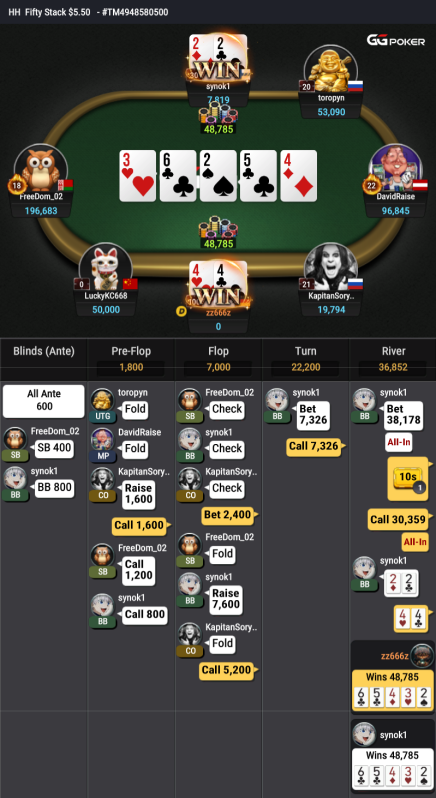
gg universe is remarkably fair and balanced now