GTO+/CardRunnersEV?

This is the support thread for CardRunnersEV, which is hand EV analysis software.
I can see if we can add some sort of cutoff.That said, it's worth noting that these lines don’t occur 0% of the time - they’re just very rare.I’ve tried to reproduce this by doing the following:1) Navigate to a node where at least one of the preceding actions is very rare.2) Select "Drill the current decision – loose."3) Sit down and started playing.When
Yes, that's why I didn't insist on not showing it when it doesn't happen.
In the trainer, this is resolved, the strange lines don't appear for me, but there was a time when it was common for them to occur, and I think you had looked into it at that time.
Now, in the aggregated reports, according to the video I sent you, when navigating to the turn, it shows flops where that bet size is used 0%.
Finding patterns of sizings and frequencies is impossible since that disrupts all types of averages.
In the video, it's clear in the last example. on the turn, it shows that 99% of the time a betsize is played from a node that no longer exists since the flop
Yes, that's why I didn't insist on not showing it when it doesn't happen.
In the trainer, this is resolved, the strange lines don't appear for me, but there was a time when it was common for them to occur, and I think you had looked into it at that time.
Yes, from what I recall, this was an issue in the trainer at one point, but it has since been resolved.
Specifically, there were cases where the "Loose" function selected lines randomly instead of by weight.
However, this issue was unrelated to what you're describing here.
Now, in the aggregated reports, according to the video I sent you, when navigating to the turn, it shows flops where that bet size is used 0%.Finding patterns of sizings and frequencies is impossible since that disrupts all types of averages.In the video, it's clear in the last example. on the turn, it shows that 99% of the time a betsize is played from a node that no longer ex
The line most likely still exists >0%, but only for a very small fraction (such as 0.001%).
It looks like there's room in the interface to add a filtering function, so we'll look at the possibility of including a filtering option for this.
Sorry for the abrupt change of topic.
We've talked several times about whether there could be a way for GTO+ to choose the sizing that retains the most EV in a Wizard-like style, to reduce the complexity in nodes where there are more than 2 strategic options (2+ bet sizings, for example).
Would there be any way to tell the software something like:
"from these 3 betting options on the turn (always considering the check range), choose X, Y, or Z" (or even 2 out of 3)..
And here's the clarification: only choose the sizing according to what the user selects (something similar to the "merge bet" function), not the one that generates the most EV, because here a fairly complex automation would be needed to achieve it.
I was thinking more like, for example, we choose "X" and "Z", then GTO+ would nodelock that Y is used 0% (never). And then manually solve with the "little circle".
Currently, it can be done in the following ways:
- applying negative incentives
- Exporting turns and editing the trees..
What do I want to achieve with this? that are quite a few clicks to work with, and maybe there’s a method like you did with the "rebuild DB" that now gives you the option to apply incentives, just change ranges, or even better tailor it to one’s needs... or even the "merge" interface

I've just updated the version. wow the equity bucket looks pretty cool
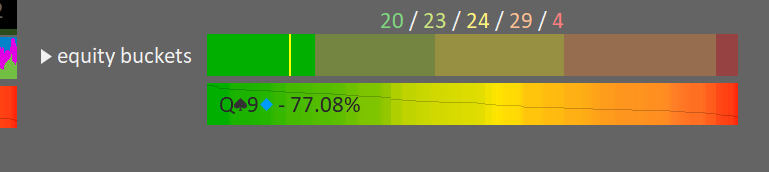
Thanks Scylla for the update
Sorry for the abrupt change of topic. We've talked several times about whether there could be a way for GTO+ to choose the sizing that retains the most EV in a Wizard-like style, to reduce the complexity in nodes where there are more than 2 strategic options (2+ bet sizings, for example). Would there be any way to tell the software something like: "from these 3 betting options
This approach wouldn’t work—not for a single decision, and it would be even more difficult for multiple decisions.
The reason is that it ignores the fact that any change in a decision's strategy will influence how the opponent (villain) plays against you.
Villain will adapt, and the strategy throughout the entire game tree will shift as a result.
It's not possible to predict these shifts in strategy by simply looking at the current EVs of individual hands.
A full recalculation of the entire tree would be required for every betting configuration under consideration.
This makes the approach extremely computationally intensive.
For example, if you want to test 3 different configurations across 4 decisions, you'd need to evaluate 3^4 =81 different configurations to properly account for how those decisions interact with one another.
That said, as noted in previous posts, from a human perspective there's relatively little to be gained by focusing heavily on bet sizing—especially when compared to focusing on overall strategy.
Any reasonable bet size will perform almost identically to any other reasonable size.
The impact of bet sizing is significantly lower than that of using the correct strategy.
Even small strategic errors can render efforts to optimize sizing meaningless.
Conversely, even large errors in bet sizing—when paired with sound strategic play—result in minimal value loss.
Unless you’re a bot with guaranteed perfect strategy, from my perspective, for at least 99% of players, there’s little practical reason to spend excessive time studying bet sizing.
Focusing on strategy will deliver far greater returns.
Hi again, just to further clarify:
Would it be possible to implement a simplified version of this idea — something more in line with how the “merge” function currently works?
The idea is to allow users to manually simplify the bet sizing options at a node, starting from the turn, without going through the more tedious “Edit Tree” process.
For example, if B33, B75, and B150 are available, I might want to keep just B75 and discard the others — but do this quickly and cleanly, node by node, as I progress through the tree.
Yes, I know this can technically be done already using "Edit Tree", but it’s quite click-heavy and inefficient for iterative work.
Many players — especially users coming from tools like PioSolver or GTO Wizard — are used to studying with fewer, cleaner sizing options, and value the ability to simplify nodes for clarity.
It’s not the same to study a turn or river spot with 2–3 perfectly balanced sizings versus being able to focus on just 1 or 2 sizings to better understand the strategic patterns.
This request assumes that the flop strategy is already defined, and the simplification is applied starting from the turn, on a node-by-node basis, not for the full strategy tree at once.
It’s not about optimizing EV or strategy globally — just a workflow and visualization enhancement, similar in spirit to the "merge bet" function, but aimed at manual pruning instead.
Would something like this be feasible to add?
�� The issue with "merge bet"
The "merge bet" function works by combining multiple bet sizes into a single one — for example, merging B33 and B75 into just B75. However, this comes with a key strategic drawback:
B33 and B75 often serve different purposes — B33 might be used for thin value or protection, while B75 might be used for stronger value hands.
When merging, the hands that originally used B33 are forced to either bet too large (losing EV) or move to check (also potentially losing EV).
The solver doesn't re-optimize hand strategies when merging — it just transfers the combined betting frequency to the new sizing (e.g., if B33 and B75 were used 60% combined, the new B75 will now be used 60%, even though that may no longer be optimal).
This can create distorted outputs and strategic inaccuracies — especially in spots where sizings have clear functional separation.
�� What I’m suggesting instead
A new feature — similar in spirit to "merge bet" but simpler and more flexible:
Allow users to manually remove one or more sizings from a node (e.g., deselect B33 and B150, keep only B75 and check).
This would trigger a clean recalculation of the node’s equilibrium based on the remaining options.
The goal is not to find the most EV-optimal configuration globally — just to help users study simplified, clean versions of a spot without editing the full tree manually or applying negative incentives.
�� Why this is useful
Makes it much easier to study cleaner strategies with fewer sizings (as done in PioSolver or GTO Wizard).
Reduces click-load and workflow friction, especially when working node-by-node through turn and river spots.
Helps players understand strategic patterns without the clutter of overlapping sizings.
This feature would offer a much more practical way to prune complexity while keeping strategic integrity, which "merge bet" doesn’t always preserve.
Would love to hear your thoughts on whether this could be feasible to implement.
Thanks again for all the continued development and support!
Hi again, just to further clarify:Would it be possible to implement a simplified version of this idea — something more in line with how the “merge” function currently works?The idea is to allow users to manually simplify the bet sizing options at a node, starting from the turn, without going through the more tedious “Edit Tree” process.For example,
�� The issue with "merge bet"The "merge bet" function works by combining multiple bet sizes into a single one — for example, merging B33 and B75 into just B75. However, this comes with a key strategic drawback: B33 and B75 often serve different purposes — B33 might be used for thin value or protection, while B75 might be used for stronger value hand
I get the impression that these texts were created with ChatGPT or some other AI.
At the very least, I notice some statements that that are simply untrue (also, the �� markers are a dead giveaway).
Please don't use ChatGPT for posting in threads - it has no real time human experience with any of these products - ChatGPT has no idea what it's talking about.
I get the impression that these texts were created with ChatGPT or some other AI.
At the very least, I notice some statements that that are simply untrue (also, the �� markers are a dead giveaway).
Please don't use ChatGPT for posting in threads - it has no real time human experience with any of these products - ChatGPT has no idea what it's talking about.
Scy, first of all, I want to apologize. It wasn't done with malice. My English grammar is quite poor (although I understand the language perfectly).
I asked him to translate what I was saying and wanted to see if he could explain it better. But it wasn't done with malicious intent at any point.
It was based on my experience using solvers.
Virtually all players build fairly complex trees to derive heuristics, and because of this, there are situations where betsizing clearly indicates one preference for use over another.
If the trees were built with only one sizing, this wouldn't be possible.
Here the Preferences: Cbet Turn Line
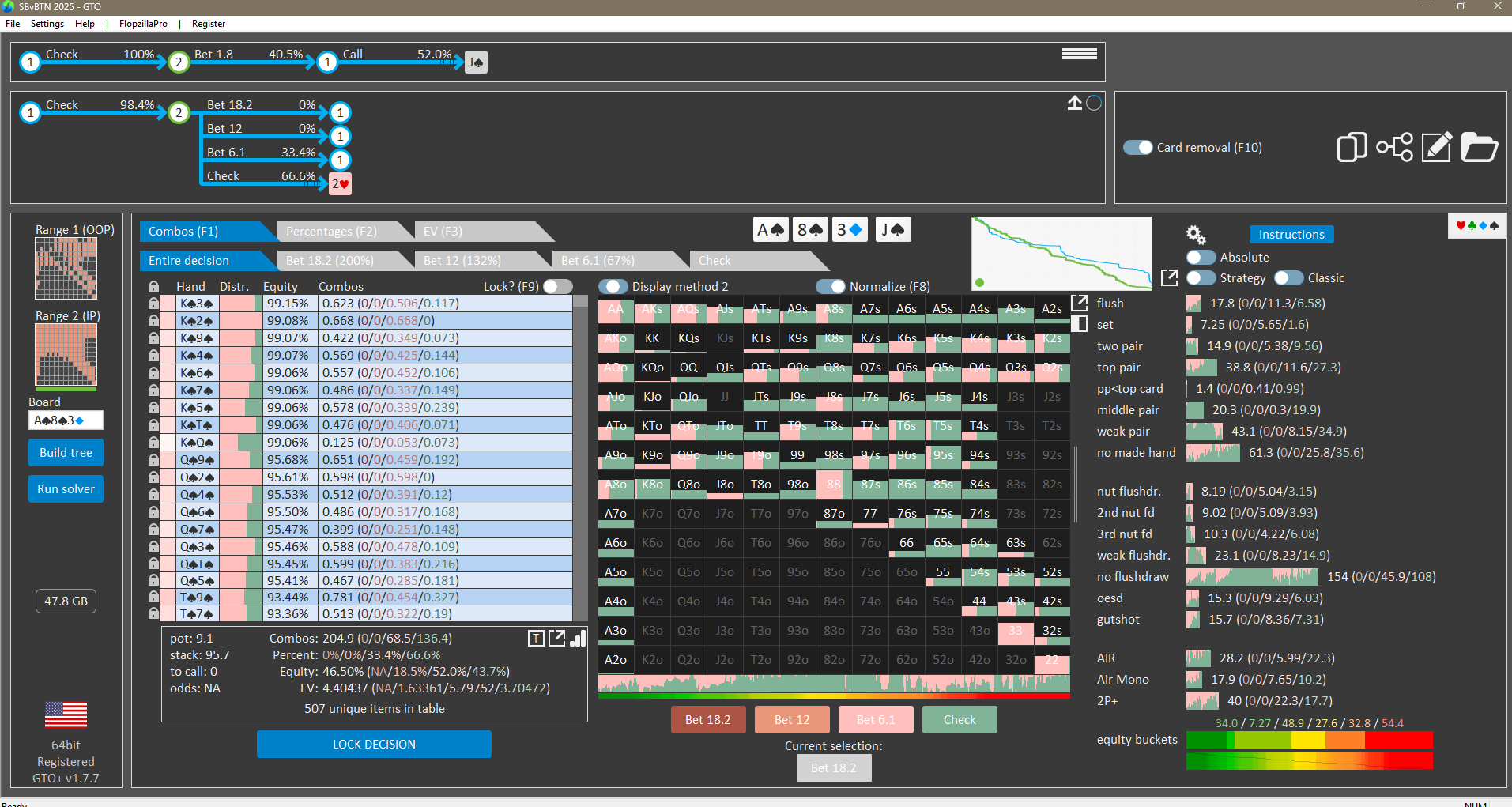
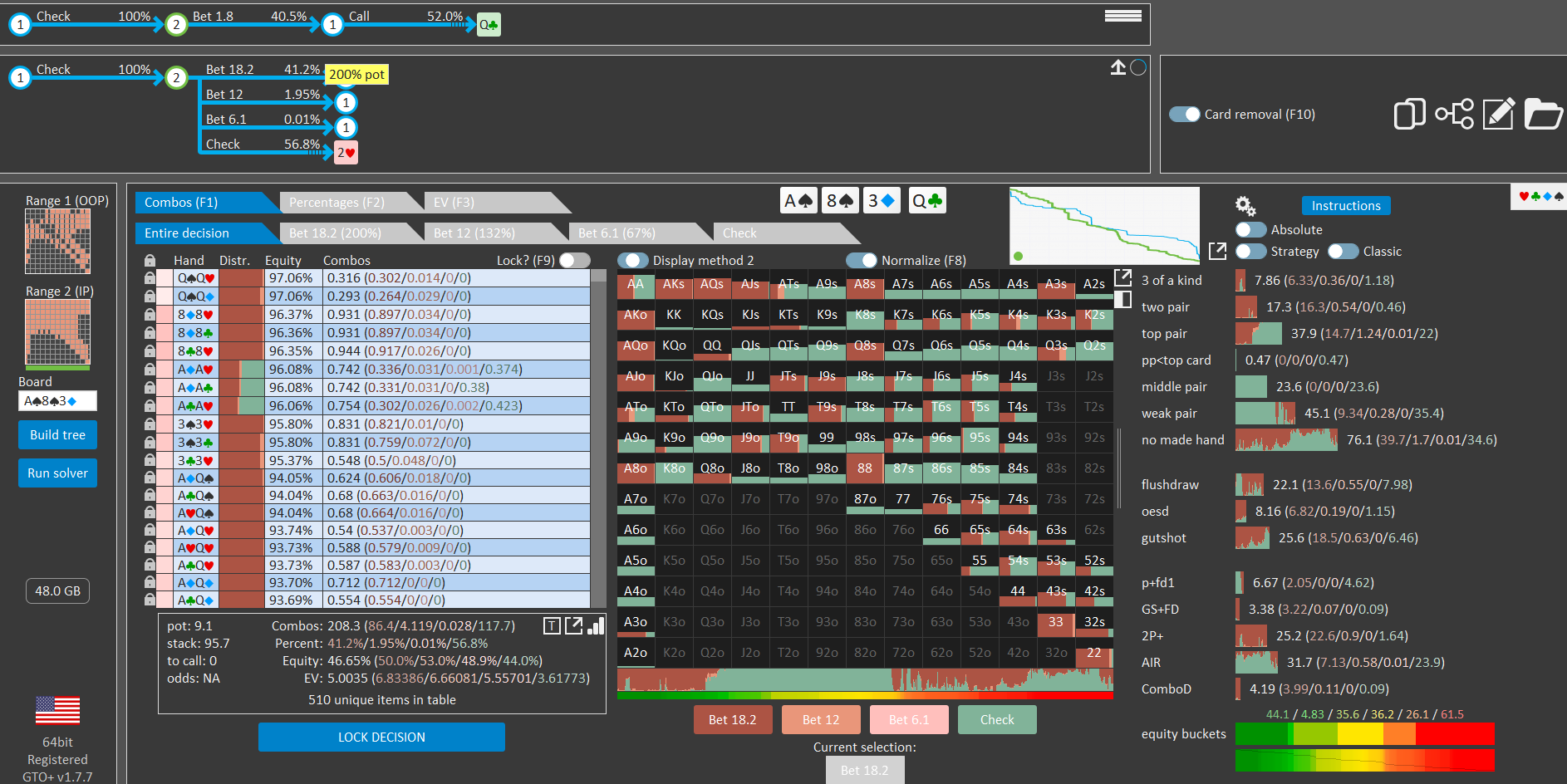
Here Turn Probe
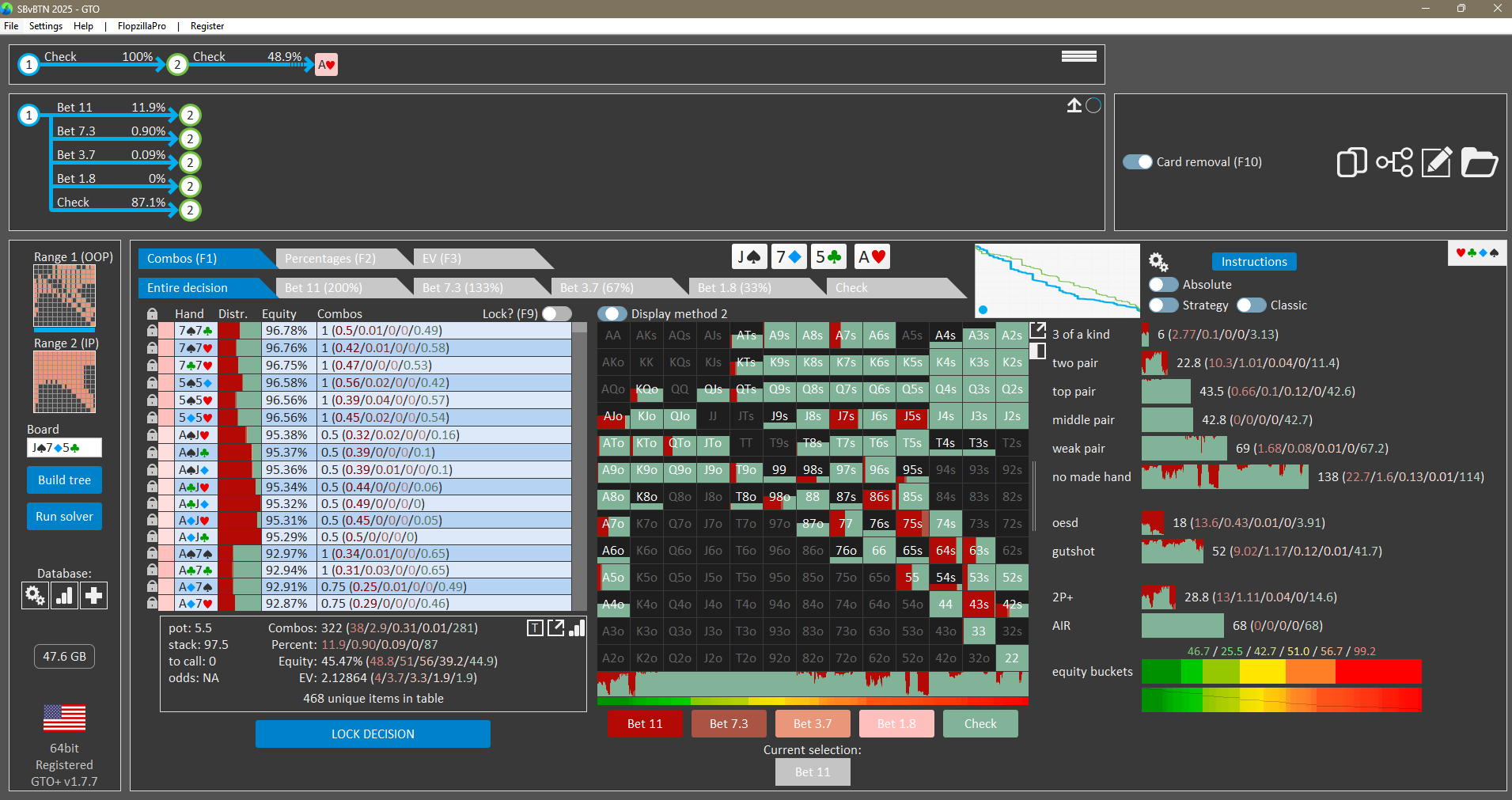
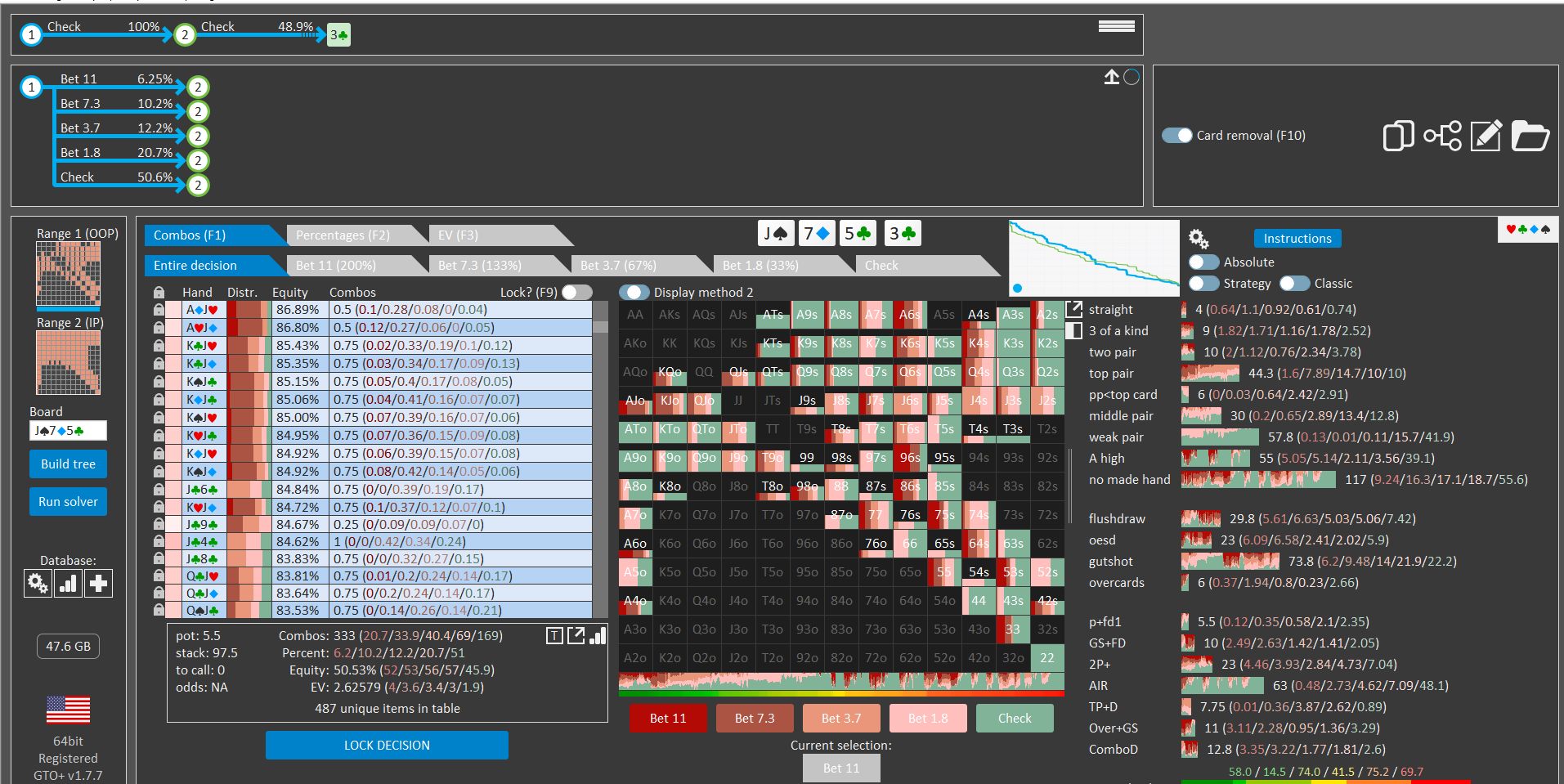
I want to point out that building "complex" trees to find patterns is the most common practice among poker players (at least in DeepStack cash games).
But sometimes you find yourself like the last "turn probe" image, where any sizing seems to fit well.
In those situations, a sizing simplification tool would come in handy.
I don't question what you say about practically any sizing having the same performance when used properly, or that there's very little difference in EV. (I think you're a brilliant person for bringing up Crev, Flopzilla, and GTO+.)
I don't know if you still play poker or if you've played poker, but I'm curious to know from your perspective what would be the best way for you to study with Solvers.
And this isn't a trick question...I think your understanding is far superior to any top reg I can think of.
It's possible that most users don't work well with these tools, but i know many of the HS Crushers have been working in a similar way at the time..
Let me just clarify what you're asking here.
See the tree below.
It's a tree that has multiple bet sizes in several spots.
Do you mean that you want to remove all superfluous sizes throughout this tree, and trim all decisions down to 1 or 2 actions?
Possibly not only for the flop, but also the turn and river?
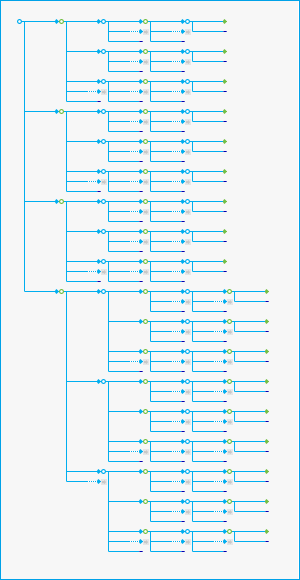
Yep, I was thinking about that. Remove or somehow tell the solver not to take that or those lines (in that specific node). Then, re-solving the node, a new, but more simplified, "equilibrium" would be created.
But in similar way to when you apply a change (nodelock, frequencies, merge, etc.) and you can revert it back to the original solved tree.
I mean, nowadays you can add or remove sizings from the edit tree. I think this tool works well for adding, because for it ,makes sense.
Now, to simplify a specific node to 1 or 2 betsizings (if you have +3) in the solved trees, being able to prune the tree from the main screen would save a lot of time, especially if you can also revert it to return to the original strategy.
I forgot to give an example.
If I have 3 sizings on the turn and I want to remove 2, I only want to do it on that specific turn or node. Not on the entire tree.
If I'm on the river, the same thing... only on that specific river.
It's not like I build a complex tree and then want to remove X sizings from there..
I'm browsing a node, and I see that the strategy to implement with multiple sizings is complex because it uses several. That's where I would apply the simplification tool.
This generally happens in probe-delayed lines and on rivers.
Flop too, but there the spot should be resolved directly again with 1 sizing (or failing that, to hold and show you the DB within GTO + work with negative incentives to cancel the strategy I don't want it to take).
Yep, I was thinking about that. Remove or somehow tell the solver not to take that or those lines (in that specific node). Then, re-solving the node, a new, but more simplified, "equilibrium" would be created.
Ok, and can you please tell me which feature in pio you're referring to?
Specifically, which menu item?
I've checked, but I can't seem to find it.
Ok, and can you please tell me which feature in pio you're referring to?
Specifically, which menu item?
I've checked, but I can't seem to find it.
its an addon..
It's an add-on to PioSolver. It's called Advanced PioTools.
Many users have purchased it.
There are videos on the page showing how it works and also explanations.
I currently have it. I selected a shortcut (Ctrl+1 for only one sizing or Ctrl+2 to keep two sizings), and it automatically prunes my trees (it also solves them automatically). It can be added to Pio, or you can run it as a separate program and leave it running.
I understand that it's doing nodelocking and testing sizings that retain more EV in the background.
I understand this is complex to plan, but the closest and most automatic option I could think of is the one mentioned in previous posts.
You can also simplify all the turns or river nodes at once, but this obviously takes a long time depending on the size of the tree. It's useful in 3-bet pots, 4-bet pots, and most likely for MTT players (which I'm not).
For SRP 100bb, it takes a while since it has to recalculate all the turns and try all the sizings, but hey, that option exists.
Do you have any other ideas?
To this day, I use both solvers.
GTO+ has the nice advantage of agg reports over Pio (you can only output them in Excel format), while here you can study perfectly from the soft.
And the new nodelock update—reverting the strategy to its original format—is amazing.
Pio is about to relaunch the new trainer (which is already a bit better in my opinion in this regard).
And AdvancePiotools is a great tool for creating simpler strategies.
Each solver has its strengths, and I'm mixing and matching between the two.
Just to clarify — your original request was for a feature that automatically trims all decisions for an entire tree across the flop, turn, and river.
However, the feature you're now referring to appears to trim a single decision, on the turn, for one specific turn card.
We can support the latter request.
The original, broader request would be too time-consuming to be practical.
Just to clarify — your original request was for a feature that automatically trims all decisions for an entire tree across the flop, turn, and river.However, the feature you're now referring to appears to trim a single decision, on the turn, for one specific turn card.We can support the latter request. The original, broader request would be too time-consuming to be practi
I may have misunderstood you, because the idea is to be able to simplify as we review hands or study a spot we're currently in.
For example, the turn probe I showed in one of the images where it's possible to use 3 sizings.
I simplify to 1 sizing on that turn, call a specific river, and it also gives me a fairly mixed solution (I generally have 4 to 5 sizings in SRP).
Here too, I'd like to apply another simplification, but as I said before, on this specific node.
If we can automate the sizing that has the best performance, we're talking about an incredibly valuable tool (again, only on that specific node and not on future nodes).
If this can't be automated, improving tree editing (by improving, I mean making it an additional tool to Lock) works very well.
I may have misunderstood you, because the idea is to be able to simplify as we review hands or study a spot we're currently in.For example, the turn probe I showed in one of the images where it's possible to use 3 sizings.I simplify to 1 sizing on that turn, call a specific river, and it also gives me a fairly mixed solution (I generally have 4 to 5 sizings in SRP).Here too, I'
If this is just a single decision, the process should be fairly straightforward.
Let’s say there are 3 configurations to consider.
We’d need to run the recalculation tool 3 times, each with the corresponding incentive.
After each calculation, store the outcome in memory, and at the end, accept the best-performing tree.
The only challenge here is that our incentive approach for flop trees doesn’t support individual turn+river runouts.
On the river, we treat rivers in bulk—for example, we assign an incentive to all rivers following a 2h turn as a group.
Without this bulk approach, the interface would be too difficult to work with.
An alternative would be to apply a lock to that specific turn+river runout.
But using incentives is likely more flexible, especially if changes are made to other parts of the tree.
All in all, as long as this is for a single decision, it’s not a technically difficult feature.
We can revisit interface options for this after v178, or possibly a bit later.
If this is just a single decision, the process should be fairly straightforward.Let’s say there are 3 configurations to consider.We’d need to run the recalculation tool 3 times, each with the corresponding incentive.After each calculation, store the outcome in memory, and at the end, load the best-performing tree.The only challenge here is that our incentive approach for flop t
That's why I made the clarification about optimizing 1 flop sizing on our own (sizing studies).
Assuming we only have 1 flop sizing, we would start using the tool on the turn and river.
There's a reason APT (advance piotools) doesn't offer it from the flop.
If the APT system can be applied to GTO+, automating the simplification to the "best" sizing on X turn or X river, or both... that would be fantastic.
When we apply incentives, it can be applied to just one turn or to all turns.
If this could also be selected, it's precisely what I was asking for from the beginning.
On the river, the resolution will likely be very fast, and the tool can be asked to resolve the best two sizings on all the rivers that could come (assuming we have already defined the flop and turn in question).
The last thing to keep in mind is to have the AGG reports display updated to the new sizing frequencies.
I hope you understand what I'm trying to explain.
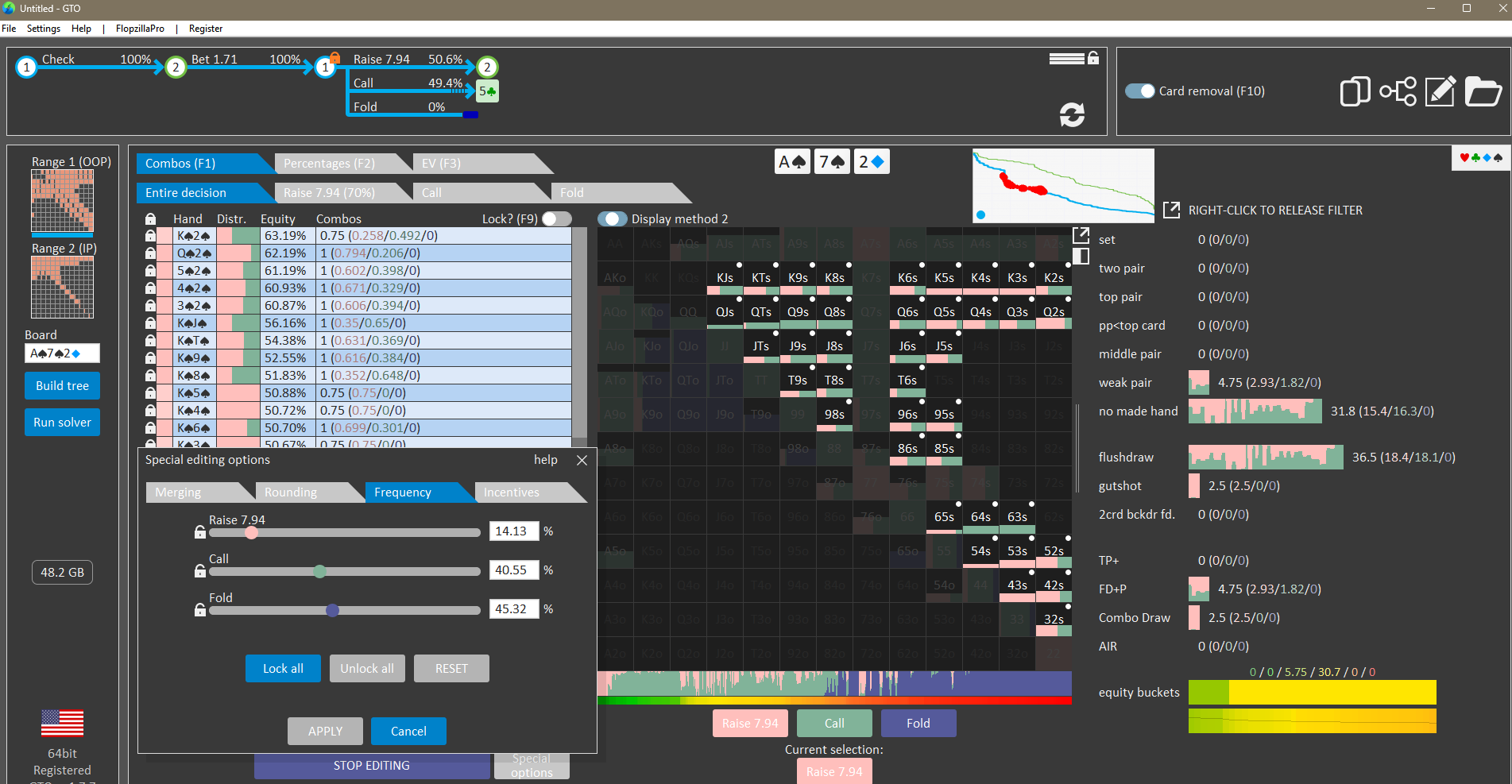
Scy, how are you?
I wanted to ask if it's possible to add the option to set frequencies by group of hands and not just by range.
In the uploaded image, I first applied color filters with the intention of changing only those frequencies and not the entire range.
Currently, you can do it manually, saying, for example, that FD raises 66% and calls the other 33%, but in a flat manner (meaning all FD combos would fall within that frequency).
Using bars, there might be a better metric to more "correctly" increase the range in question.
Thanks as always.
I have some personal obligations today, so let me get back on this, and possibly any other posts, tomorrow.
Oki .. When I say "color" in my previous poist, I mean "flush draws".
I hope all your things are in order.
Thanks as always, scy.
Scylla,
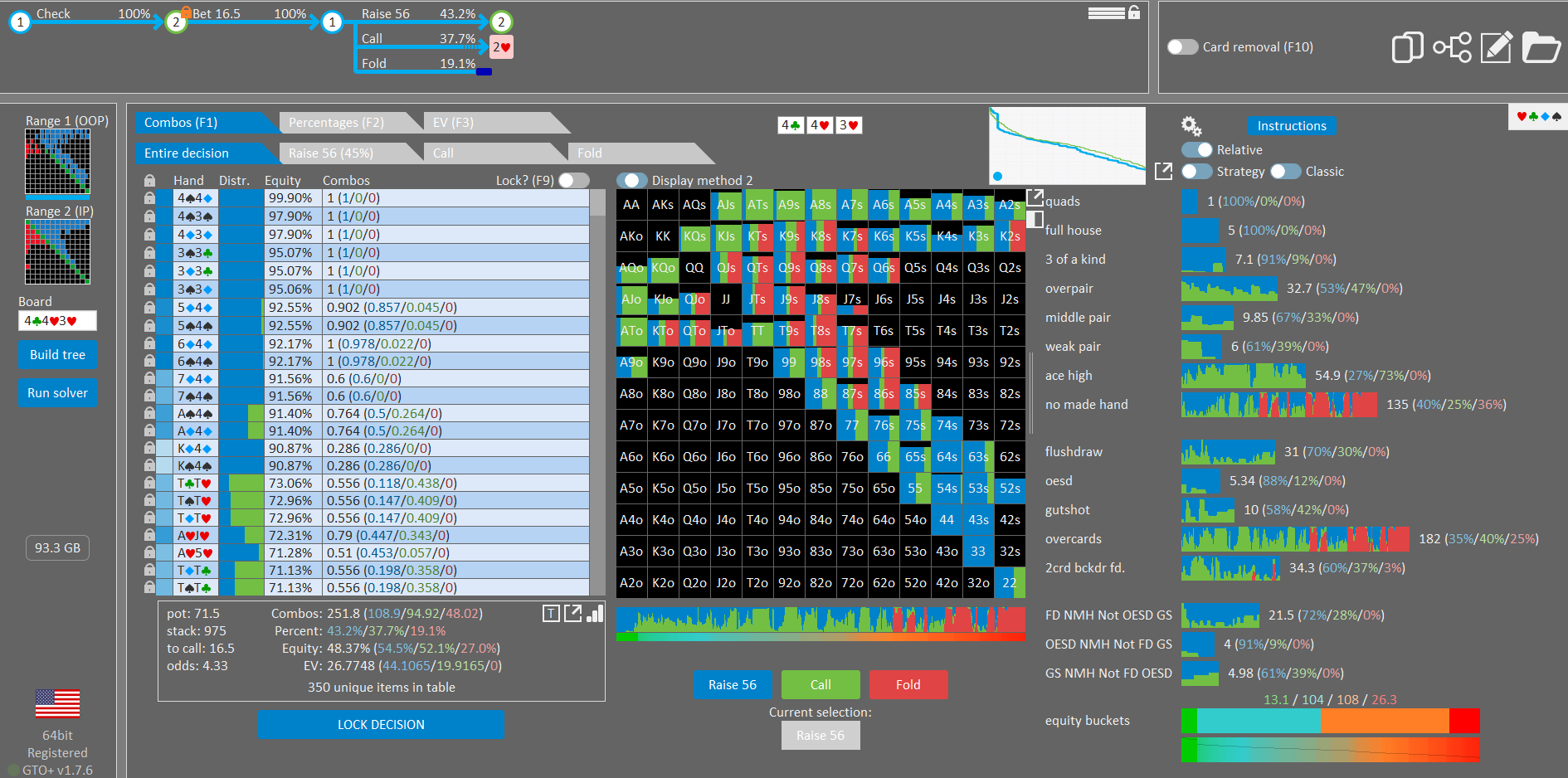
I am confused by the % of raise size in this example
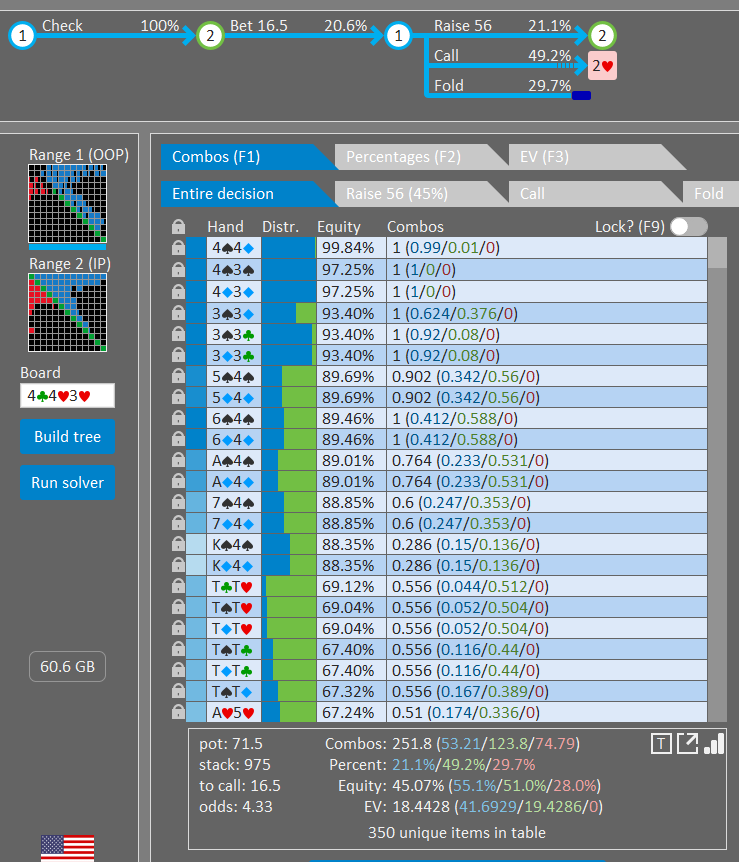
Original pot on flop = 55
IP bets 16.5
pot is now 71.5
OOP raises 56
highlight the raise and it says ~ 45% which is the allowed raise size
if I use the formula (3 * bet) + (pot) * % I get 54%
How is the raise size calculated
Scylla,
Is there a way using GTO+ and Flopzilla to copy a range string into a spot say on the flop facing a bet. I was able to export from the sim into Flopzilla using the export function and now I want to
paste that string into a node locked sim. I want the new nl sim to use the response to the bet from the unlocked one. For example IP NL to b30 100% and OOP doesn't adjust and plays the response as if IP is not locked.