Climate Change - increasingly horrible disasters loom

...............
there is so much out there about this - I don't really need to provide a lot of sources - a quick google
Part of me wants to move somewhere where I can ride a horse everywhere instead of driving.
If relocation is an option, I recommend somewhere adjacent to the Great Lakes or extreme northeast for Americans who want to be best positioned to deal with future climate changes. MN, WI, MI, Upstate NY, VT, NH and ME will experience climate migration in their direction.
No place is immune from consequences, but that's a region which is more insulated from coastal weather, freshwater shortages, wildfire and batshit crazy governance. Homeowners insurance is less likely to spike in cost.

You are missing the point so much it's quite rare from you.I'm talking exclusively about the steamraise post and your response here.No one argued there is no problem and we must not take it seriously, that was a given ( but I guess not so much if you had to word your answer that way).My point is you absolutely need complete transparency when talking about climate change, and av
I will admit to not reading the post, as I do not read Facebook posts. However, I don't think posting the picture and saying that this is the future is alarmist, but I guess we see different things in the image and the claim that comes with it. Obviously it is not something that will happen to all freshwater bodies, and if people interpret the picture that way, then maybe it is overselling things. However, I don't think it has to happen to every freshwater body to ruin us.
Many freshwater bodies that are fragile due to geography or made fragile due to human intervention (or a combination thereof) are already disappearing or having their volumes reduced to a catastrophic degree as climate change thumbs the scale. As water levels reduce, the ratio of water to minerals and salts decrease, often making ecosystems collapse as the water can no longer sustain the life they used to support. Projections are fairly clear in telling us that this is not a fluke, and that the problem will grow far worse.
Freshwater supplies in the form of groundwater is also similarly hurt, but to make matters even worse, many aquifers (the soil compositions underground that make it possible to bind water) have a composition of clay and silt, and as these dry up the structures that makes it possible to bind water are also destroyed. Meaning that not only is the water disappearing, but in many places we are also destroying the possibility of water returning. This is also similar to what is happening to wetlands all across the globe, which are not only destroyed and reducing at an alarming rate, but structural changes that result make their return at a timescale that matters to us unlikely. Impact on water availability on water supply and its direct impact on crops, combined with the indirect impact on agriculture that has become less and less diverse and thus less resistant to change is something I suspect will lead to increased breakdown of global order, which will in turn hinder our ability to tackle the disasters that await ut us.
I do not say any of this to be doom and gloom and alarmist. I don't panic about stuff. I'm not much of a worrier, but I enjoy being a realist.
I don't think we are heading towards a cliff, I think we drove of it years ago and right now the debate is mostly to determine when we will impact the ground.
Our chance is that we can develop technology and knowledge at a pace quickly enough to save our way of life, but this is not something we are really focusing on, instead the efforts are fragmented and underfunded and we can not even agree that there is a problem.
We're like seagulls slathered in oil spills, squabbling over who gets the last fish.
I don't think we are heading towards a cliff, I think we drove of it years ago and right now the debate is mostly to determine when we will impact the ground.
That's a sentiment I can agree with.
I think the collision with the ground is already happening in slow motion.
Inflation, water shortages, flooding, sea level rise, heat waves, wildfire, plastic accumulation ..... it's all building.
That's a sentiment I can agree with.
I think the collision with the ground is already happening in slow motion.
Inflation, water shortages, flooding, sea level rise, heat waves, wildfire, plastic accumulation ..... it's all building.
Yes, it is.
The way see it, we have already had the first climate change war (Syria). While climate change does not start wars (that is very much a human endeavor triggered by our own motivations), it can create a scarcity of resource and economy that is like kindling to strife and conflict, so it is much easier to start such conflicts.
In the Iran war, we see the exploitation of the effects of climate change through the attacks on water reservoirs, water supplies and desalination plants. Like Lake Poopó, the scarcity of water exploited by these attacks are not solely caused by climate change, but it is once again the thumb on the scale. So not only can climate change create situations where conflicts are more likely to happen, it can make the impact of war a lot worse.
I see these as warnings about how ill equipped we currently are to deal with these matters as things grow worse.
It is not impossible that we some day get the equivalent of the Montreal Protocol in regards to climate, and I certainly hope we do. The alternative is grim.
It is not impossible that we some day get the equivalent of the Montreal Protocol in regards to climate, and I certainly hope we do. The alternative is grim.
The problem is that the American govt is paid for by the highest bidders whose wealth is measured in short-term cash flows. Renewable energy doesn't generate short-term wealth the way fossil fuels do and renewable energy isn't dense enough to fuel the 100,000 flights a day which wealthy people consider themselves entitled to.
Clinton-Gore gave us the Kyoto Protocol which was so weak that the Senate rejected it unanimously. Not even a single Democrat Senator was willing to vote to ratify. Obama gave us the Paris Accord which contained zero obligations or jurisdiction. There is a massive illusion that the Dems are materially better than the GOP which is of course comically awful on the subject.
The US became the world's largest fossil fuel producer during Obama's tenure, surpassing the Saudi's and Russia.
The epitome of Dem corruption is letting a coal broker like Joe Manchin dictate the terms of the IRA and be appointed the party chair on the Senate Energy Committee.
Can we all just admit we're in this predicament (mass public skepticism about global warming) because of the pro global warming camp and their stupidty?
- Numerous lies from scientists
- Numerous claims of imminent disaster that never pan out
- Magnified by the media, endless clickbait where everything that happens (fires, floods, extra snow, less snow, hurricanes) are all caused by global warm, despite 80+% (100% in the case of hurricanes) not being caused or made worse by global warming
https://web.archive.org/web/201508120305...
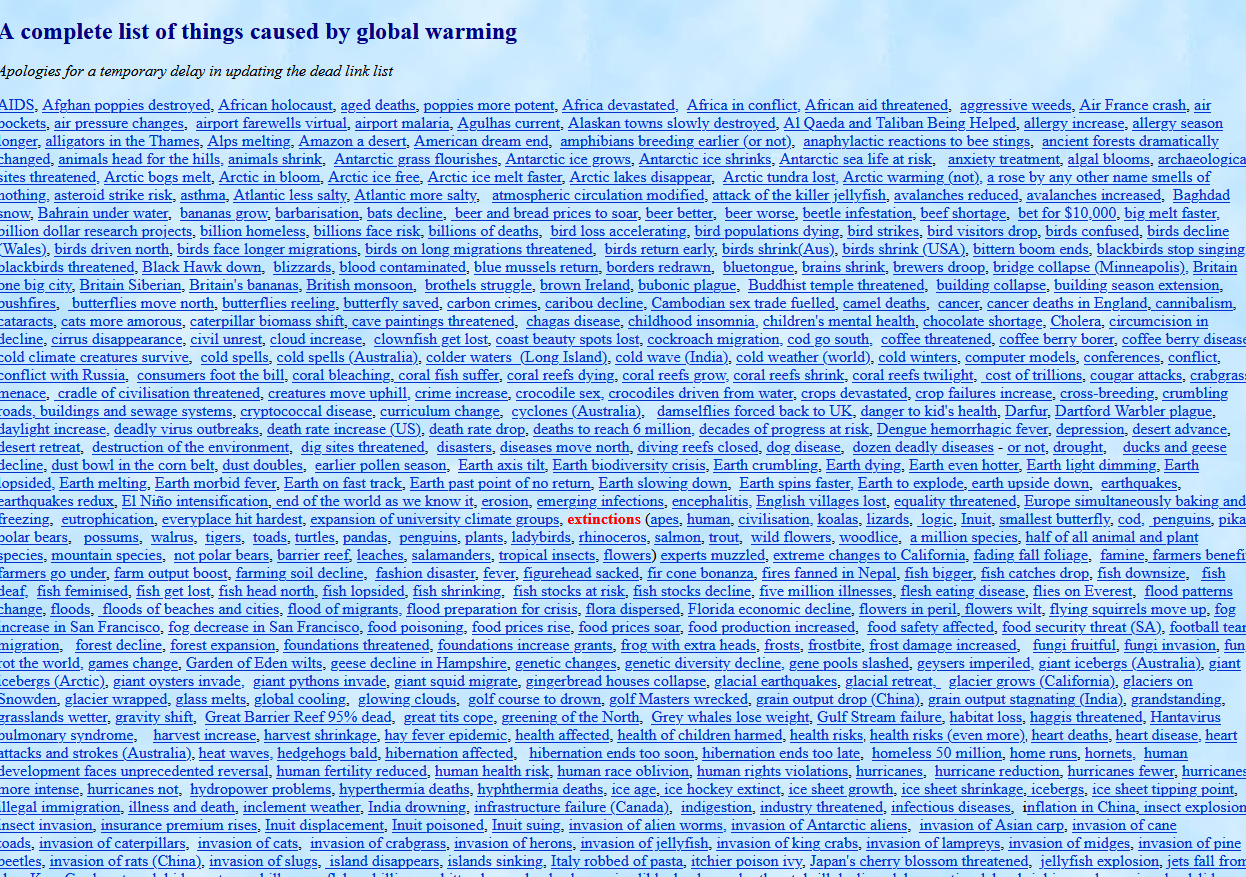
- A catastrophe and negativity focus and complete lack of honestly in reporting the positive of global warming (higher plant growth by far, global greening, more stable and reliable cropping, richer ecosystems on margins, far fewer cold deaths)
- Deep dishonesty and stupidity and no hard reckoning about the causes and solutions (pretending that solar and wind are viable answers rather than disasters that hurt the poor)
Regular, reasonable people see all this and see an extreme lack of seriousness and perspective and call it all BS, and rightly so.
complete lack of honestly in reporting the positive of global warming (higher plant growth
You're a moron.
Very simple chemistry for you which explains the balance between plants and animals.
Animals (and fossil fuel burning machines) have CO2 as a byproduct. We use oxygen and water and organic carbon compounds to create energy.
CH + O2 + H2O ==> CO2 + H + Energy
Plants use CO2 and water in photosynthesis providing the organic compounds and oxygen animals need
CO2 + H2O + sunlight ==> CH + O2
The atmospheric concentration of CO2 has increased from 280 ppm to 432 ppm in the last 150 years. Each ppm weighs 7.82 billion tons. That's 1.2 TRILLION TONS of CO2 that has been added to the atmosphere because plants don't have the wherewithal to use it all. That's roughly 7x the weight of Mt Everest.
The world cooled by several tenths of a degree when the partial contents of a much smaller mountain (Pinatubo) let off the contents of a short-term cooling gas (sulfur dioxide).
CO2 is not a quick acting and fading phenomena like the sulfur dioxide of Pinatubo. And it is a warming phenomena, not a cooling phenomena.
7 Mt Everests of CO2 in combination with the massive increases in atmospheric methane is enough to raise average global temperatures by ~ 4C over about a century. That's much more than enough to end human civilization and threaten humans with extinction.
Please crawl back under the hole from which you emerged.
Very simple chemistry indeed! Let me give you some real chemistry, you intellectual redneck. Listen up because school in session
Plants are WAY better off with higher CO2. Several reasons, but the biggest one is that is helps them resists drought and thrive on less water because they can keep their stomata less open; the reaction surface improves from more CO2 and they lose less water.
Actual non-clown chemistry:
[QUOTE=THE AI LAUGHING AT CLOWNBOY NUT NUT]Photosynthesis: 6CO2 + 6H2O + light -> C6H12O6 + 6O2
The same stomata that let CO2 in also let water out: H2O (leaf) -> H2O (air)
When atmospheric CO2 rises, plants don't need to open their stomata as much to capture carbon. Less stomata opening means less transpiration, so soil moisture lasts longer and plants can survive dry conditions better.
Higher CO2 also reduces photorespiration in C3 plants such as wheat, rice, soybeans and most trees. Rubisco (ribulose-1,5-bisphosphate carboxylase/oxygenase) can react with either CO2 or O2.
RuBP + CO2 -> 2 x 3-PGA (productive photosynthesis)
RuBP + O2 -> photorespiration (wastes energy)
Higher CO2 increases the CO2/O2 ratio around Rubisco, causing more productive photosynthesis and less wasteful photorespiration.
Result: plants produce more biomass per litre of water and are generally more drought tolerant, especially C3 plants.[/QUOTE]
CO2 has been a massive net positive for the plant biosphere, for cropping and food stability. But you don't even know that, because, as I said, the scientists and media lies to you and only presents only one side. Regular people see that and rightly lose trust. CO2 addition is bad overall (you would understand I agree with that if you had reading ability above a chimp), I'm talking about the cause of skepticism for this truth in the public and how the scientists and pro global warming activists are responsible for this.
Don't leave school kids, you will end up like Nut Nut.
One of the frustrating things about anonymous social media.
The urge to debate with scum like pokerandfootlover.
They can throw garbage over the transom and run away and hide. They can't sit still and be required to answer questions.

Very simple chemistry indeed! Let me give you some real chemistry, you intellectual redneck. Listen up because school in sessionPlants are WAY better off with higher CO2. Several reasons, but the biggest one is that is helps them resists drought and thrive on less water because they can keep their stomata less open; the reaction surface improves from more CO2 and they lose less
While it is true that plants and trees are better off with more CO2 that isn't the problem. The problem is that every year there is massive deforestation. So the total number of plants and trees are being reduced annually. So while the plants and trees that are still around may be doing better, CO2 in the air is increasing, and as a result temperatures are rising.
One of the reasons that deforestation is problematic is fires. They are happening at a much higher rate as a result of the increase of heat and lack of water, which is a direct result of the increase in CO2.


"Global Deforestation Rate
The global deforestation rate has slowed in net terms but increased in gross tropical terms. The FAO’s FRA 2025, released in October 2025, reports that gross deforestation dropped from 17.6 million hectares/year in the 1990s to 10.9 million hectares/year in 2015-2025. Net annual forest loss fell to 4.12 million hectares/year over the same period, down from 7.8 million in the 1990s. “Net” means new forest (reforestation and natural regrowth) is subtracted from gross loss.
However, forest expansion is slowing. New forest area added fell from 9.9 million hectares/year in 2000-2010 to 6.8 million hectares/year in 2015-2025, according to FRA 2025. As expansion slows and fires intensify, the gap between gross loss and net recovery may widen."
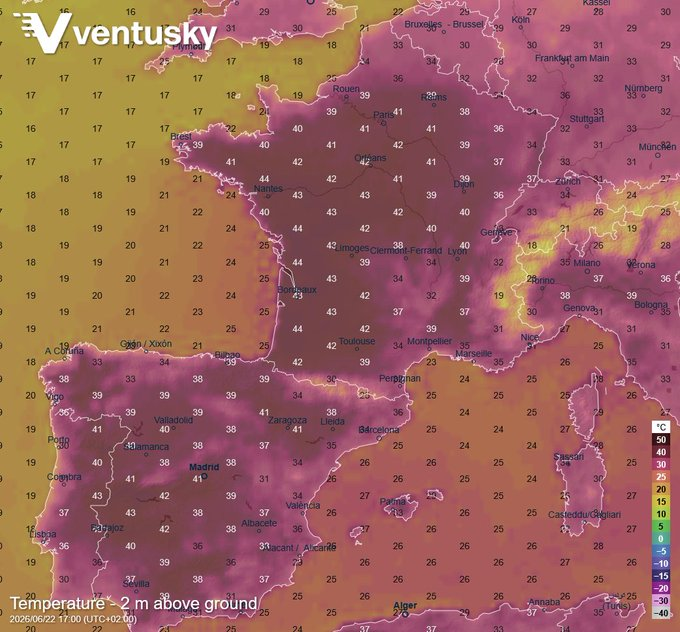
Temperature forecast for France in the coming week.
FYI = 40C = 104F. So temps in some places will approach the 110F range.


Plants grown under elevated CO2 tend to produce larger yields with lower nutritional quality. Wheat grain protein drops by about 7.4% under high CO2, driven by reductions in several essential amino acids. The mineral content of staple grains also declines. In rice, iron fell by 5.2%, zinc by 3.3%, and copper by 10.6%. In maize, iron dropped by 5.8%, zinc by 5.2%, and copper by 9.9%.
https://www.youtube.com/watch?v=iw9AiEG-...
A well articulated video related to the potential for AMOC collapse.
For those unfamiliar, AMOC stands for Atlantic Meridional Overturning Circulation.
The AMOC last stopped about 13,000 years ago as Earth emerged from the most recent ice age. A new stoppage would likely be an event that would end the version of human civilization which we are all accustomed to.
The AMOC delivers an extraordinary amount of energy to the N Atlantic region. Places like the UK and Scandinavia would become largely uninhabitable as a result of the lack of heat. AMOC also sucks enormous volumes of water off the US East Coast. Stoppage would result in rapid sea level rise in that region of up to 0.5m. Rain and wind circulation around the world be altered in a fashion which would jeopardize the food supply for billions of people.
Scientists are developing more refined models for detecting AMOC strength. That is a big part of the subject matter of the above video.
https://www.youtube.com/watch?v=Qa4rI0Va...
Another video discussing the same new research as the above video.
The hard part of understanding climate science is that most people lack the curiosity to zoom out and study the world through large expanses of time.
For the last million years, the Earth has regularly oscillated between ice ages and warm periods over cycle times of ~ 100k years. That's 10 repeating cycles. Humans have been around for 3 of those cycles.
When we transition from an ice age to a warm period, a shitload of ice melts and sea levels go up 400 feet. All of that melting ice changes the salinity of the water in the Atlantic and stops the ocean circulation. It's a regular recurring event on time scales of 100k years.
We are heading for something unique in human history. An AMOC stoppage which is not associated with transition from an ice age into a warmer period. We are headed for an AMOC stoppage associated with a transition from a warm period into a much warmer period in terms of global average temperature.
These are developments beyond the comprehension of small minds.
Nut Nut lost his nut after getting owned so hard (self own really since he couldn't read or think critically, softball for me). Now so tilted he's rage posting scare articles about the AMOC lol. That's old school (2000 era), good times!
Nut Nut lost his nut after getting owned so hard (self own really since he couldn't read or think critically, softball for me). Now so tilted he's rage posting scare articles about the AMOC lol. That's old school (2000 era), good times!
It would be a lot of fun to drag you into a conversation about science and data.
All you have is insults.

The hard part of understanding climate science is that most people lack the curiosity to zoom out and study the world through large expanses of time.
Nearly every living human being has been curious and thought about this.
This is a big reason why everyone gets sick of talking to you, and why you're reduced to reposting the same thread and arguing with the current alt account of the week.
The fact that you bold lower nutritional quality and not larger yields (and give no numbers for the yield) just drives home the point.
Let's look at the relative numbers:
A major review of 27 years of FACE experiments found that C3 grain crops (wheat, rice, soybeans, etc.) averaged about a 19% yield increase under elevated CO₂
We have 20% more food for the same land area* from CO2!! That's huge. It means better nutrition because there are more higher quality crops for the poor to eat and then don't have to subsist on low quality ultra low nutrition like cassava. Less hunger, More stability through bad years. Less water use. Less land use/conversion from forest to farmland. All from CO2
Against that we go from 10.7mg of iron per kg to 10.2mg of iron per kilogram - a meaningless drop, and only because the plant is growing more because it's more vigorous (i.e. what we actually want).
* I can bold too!!
The videos on AMOC are only about 15 minutes long pokerandcocklover.
I'd be interested in your critique of them.
Question #1 for you cocklover.
What factors determine the surface temperature of the Earth ?
Go ahead ... dazzle us with some science.
I invite people to spend 15 minutes listening to Carl Sagan's Congressional testimony on the topic.

