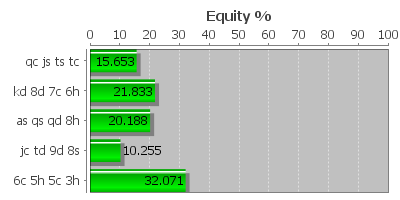
suntauri

suntauri
archangelAbout
math magicianno showdowns from villain but I felt he's playing back at us [this hand, then 3betfolding vs chipleader's open, then another hand].
let's assume he's good so that I can improve my understanding against that kind of players.
let's start with b20. what sizing are we talking about? b50 instead? does that make it more safe to not be played back [by that kind of good players trying to exploit you]? these plays occur more often deep in my tournaments.
I felt like betting the turn during the hand but had not much time to act.
so let's say we're betfolding, what sizing do we choose? b25 to fold out his air that we're not willing to bluffcatch with our hand on the river? or b50 to maybe sometimes also fold out 3x, pockets, Ax wheels, stuff like that.
I really wanted to bluffcatch him but no matter how long I stared at my hand it didn't become an ace high bluffcatcher.
another question: if he chose to checkraise flop with bluffy hands and then the offsuit king drops off, wouldn't he keep barelling? or is it legit for him to go into checkraise, check, bet pot on river line with his bluffs? maybe because we're shallow stacked.
and if he actually had something strong on the flop [not 77] or Kx and he's good, would he barrel turn?
So altogether Im right that this kind of good player would end up overbluffing in this exploitative "playing back" line and that we can bluffcatch him here with anything that is at least ace high?
do you see his small flop raise indicative of him searching a cheap bluff [against b20]?
I checked it in my free version of gtoWIZ and the solver plays it exactly like me [in chipEV], but I dont think the solver would play villain's hand in the same way as he did 😃
so the last point, him valuebetting his [high] pockets potsize on river because he expects a lot of light bluffcatching would be too overkill thoughtprocess in that situation in that tournament?
does he even have missed lowcarded straight draws [that we beat, like 45, 46, 56, or missed flushdraws] in that line (or A4, A5 which we do not beat)? or would he keep barelling the turn with them on the offsuit king?
do you think 45, 46, 56, A4, A5 are in his preflop BB defending range vs UTG when he has 21% vpip?
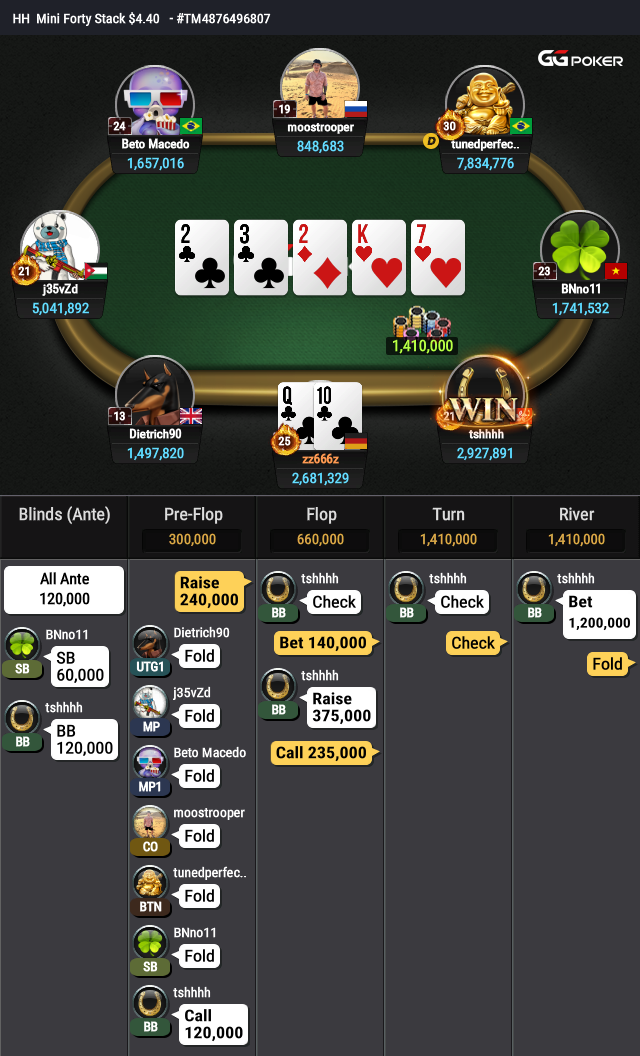
4.40$ GG mtt with 2k players, stage: last 25
opponent appears active and reggish, vpip 21%
we raise QTs from UTG with around 28bigs, opp in big who covers us completes.
on the low flop we call a small checkraise against our 20% cbet with a flushdraw.
offsuit K on the turn goes checkcheck,
then opp fires an almost potsize riverbet on a 7 blank.
I felt ugh and folded.
What hands can our opponent have here? how wild is he willing to checkraise UTG's small sizing on that flop? can he be bluffing us with a better hand [A4, A5, ...]?
Does he ever have a strong hand there like a king, a deuce, or threes full that he checks on the turn? does he valuebet the river potsize with pocket pairs?
In real life almost always going postflop > staying preflop, since you'll be able to "play", listen to timing tells, your feel for the situation, any reads you have. even your opps name, avatar or country may tell you something. live even more. you may implement "fake" timing tells.
humans can do that and gain additional edge that solvers cant.
in exploitative reality I believe beautiful hands like this will find more money postflop,
so when I see QJs in the big, I call. It doesnt feel that profitable to shove over UTG who will oftenly call you off with hands you're in bad shape against, and exploitatively you'd be winning more dollars postflop than pre through fold equity.
I guess nuances in such spots about what suited broadways the solver shoves and doesn't shove wont mean much in reality, since in most situations your opp's ranges and deviations from solver's play will be too big.
I guess not taking marginal +chipEV spots is legit. by +chipEV I mean your personal chipEV evaluation or feeling of a practical [exploitative] situation [not +chipEV in a solver, which is for GTO vs GTO].
what flaws do you see with ICM? @G-Englar
can you somehow show that you have a strategy that makes more dollars [besides more wins] than if you played ICMish, through your personal data?
@tombos
imo it's still possible that things play out differently in practical [exploitative] reality, because people play like people and these models don't account for it. I don't have enough personal experience or data though to have a good enough feeling for what's going on, so as of now ICM seems to be an adequate model.
since it's a bounty tournament I thought ICM effects are smaller and his bounty is worth quite a bit. 1st place pre bounties was around 150$, 3rd like 75$ and so on
starting stack 10k, starting bounty 1.25$
Ive been ready to get it in if he shoved (because of his bounty),
as I thought AK and if he's feeling wild AQ go into his 4bet-shoving range
but I had no idea of his nonallin 4bet range and how to react. he started the hand with around 40bigs.
does anyone know how a big bounty in a spot like that influences the dynamic [regards 3bets and 4bets] between reggish players? was my opp in above situation to be expected to have polar 4bets, being covered and having a big bounty, or only strong holdings in his 4bet non-allin range?
in normal ante mtts online, imagine you're down to your last few bigs in the range of 1-3 big blinds.
at first one may think these spots are relatively less important, but think of how the correct play here may leverage itself into your future stack development. after being almost out of the tourney, you got lucky and find yourself on the final table. would you prefer to have 50% more chips now? let's think about what happened earlier when we had 1-3 bigs.
if we wait longer, we know we'll have to be allin in the big blind the next time it comes around.
with every hand that we fold, ante eats relatively more and more of our stack. if we have 1 big, it's already around 10% ante for one hand.
at this point, do we want to get it in with any 2 cards? or do we want to keep waiting on a decent hand or a decent spot?
if we happen to end up with 1-3 bigs UTG and some trashy hand like 82off, do we fold and be allin in the next hand in the big, or do we go allin now?
consider this: we're for example on the BTN. if someone raises before us and we get it in against him, the odds we're getting are much better, our stack will increase by relatively more than when we get it in vs the big.
having such a shallow stack, what strategy is best?
fold, their ranges are too strong in these positions, Id get it in if I had like 2 or 3 bigs (and only because UTG will likely fold so it's relative to your stack a lot of dead money in the pot)
If you dont shove (from the small blind), do you call or fold? [in the average situation from above]
all mentioned (not in detail though, wanted to keep it somewhat general for general heuristics), we're fivehanded so it's midpositionish. stack distributions something along those lines. normal 500 player gg tourney final table payouts
Im in the small, not closing the action. isnt it just a fold? let them play and bust.
yes 70 bigs .. GG finals with blind rollback. I now thought if one ends up having that stack, just fold to 2nd place 😃
okay about the hand:
I really thought he may reason himself to folding, to what extent by your opinion would a reggish player want to enter the pot in that spot against another reggish player with suited broadways or something as strong as he had, AJs, both around equally bigstacked (though he covered me)? he's sandwiched there with button possibly overcalling. not much room for him postflop in such a case. maybe he just assumed I may be rather fishy and button too.
Id always snapcall here 😃
seen to many times opps showing up with random air on these limits.
there, youd expect frequent value bets by weaker holdings than KK. they can have the occasional TT, JJ, slowplayed QQ. Theyd oftenly (relative to the great pot odds that you get) bet a 9 into you, even after that action. many missed draws (hearts, lowcarded straight draws) that theyve been sticky with IP especially after your smallish bets. would they bluff for that sizing? oftenly not, but it can happen. so I always call.
how would I play the hand?
flop I cbet, turn I likely check-call, and river I decide. going into bluffcatching mode on the turn feels right for me. if they check and another Ace drops off on the river (that would have been scary for them on the turn, so you may get many pairs to fold if you cbet turn, it's a card you could use for bluffing, but if you want thin value from a 9 or something, you're rather going to get it on the river), you can valuebet KK on the river into their pairs and stuff.
so if you wouldve called on the river, I feel like most of the time you'd get to see an ace (or better), but oftenly enough you'd win.
if you've reason to assume opp is reggish I would fold though, don't see how he would bluff for that sizing and valuebet weaker holdings than KK. sometimes you see brazil players bluffing for small sizings, once I got shown an underpair bluff that me fold my top paired ace just because I thought he's not bluffing for that sizing. before that I didnt feel like thats a thing (I dont think it's likely in your spot though)
I know of coinpoker and some german players in an eastern fund seem to "fake-verify" through an affiliate to play on betonline / championpoker.
I want your opinion on my ICM punt in this 2k player tournament having 70 bigs and being 2nd / 3rd in chips,
resulting in getting chips in against covering stack on the turn and busting 8th when his flush hits on the river.
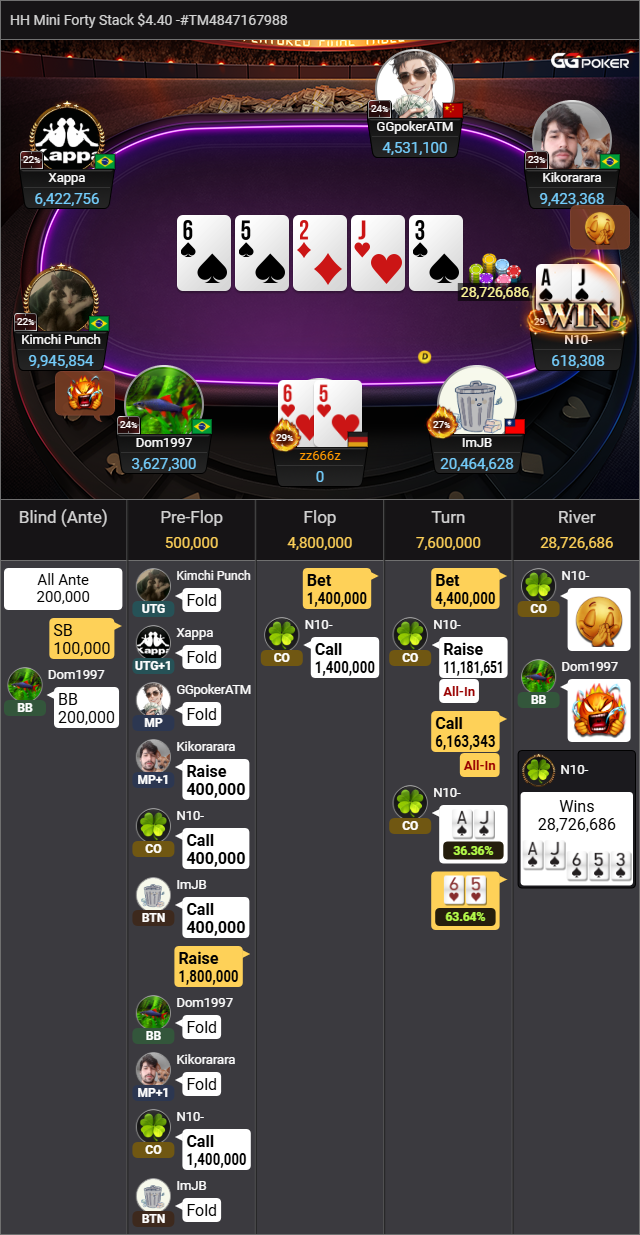
three players in late positions enter the hand, I am in the small blind with 65 of hearts.
perceiving weakish ranges from my opps in late positions, I want to 3bet pressure them, having thoughts like:
- especially the button overcalling as 3rd will have a weak range
- the other two reggish players being sandwiched will have a difficult time playing when calling my 3bet and going postflop, so they may find tight folds in this spot
- If for some reason we happen to go postflop I oftenly just win the pot on the spot with a small cbet
- I connect well with low boards ... as in the hand 😀
- I can represent strong hands on high boards as the 3bettor
- Im almost chipleading (or chipleading) if I win this hand
anti reasoning as to why NOT to play the hand as I did:
you already have 3 players in the pot ... let them bust, don't interfere!
Wins are nice, so some 1%ish may feel like a worthy tradeoff. No one wants to cut his winnings by 20% for ignoring personal Icm implications.
You've heard of the idea of beautiful future game chipleading the final table. In ICM, the chipleader gets to realize nice +chipEV spots against the rest. However it's already his "natural" baseline strategy in ICM. The question if one should actively pursue to get the biggest stack would imo require exploitative potential of pressuring the table that goes beyond of what the chipleader already has as his strategic baseline in Icm.
On final tables that are filled with more (weakish) regulars than fish, is that additional exploitative potential realistic?
Some fish may even play anti Icm, so your ability to realise through them tightening and overfolding may be lower. In Icm, if people, being bad, nervous, or tired, just drop out left and right on finals, you get to be incentivised to tighten even more.
Are players who play purely for the win and know how to play big stack practically winning more? Or is Icm to be trusted and realizes you more dollars?
Let's say we have a final table with avg stack 40 big blinds, all players stacked from 15 to 80 bigs, we're five handed.
We have a stack of 20 bigs and get TT (a middle pair from 88 - TT). Chipleader opens, we're in the small blind. Do you reshove?
Midtourney I reshove +chipEV.
Here I happened to call pre and went postflop as I felt that's more aligned with Icm considerations. So I lost the pot postflop.
Later when I got dealed 99 in the small in a similar situation again against chipleader's open and what I perceived to be a not so strong call on the button (any slowplay's from midstack button here? Or generally strong holdings? I'd never consider reshoving if it was an early position overcall as more nutted hands have to be expected), I just reshove.
Chipleader called my 20 bigs off with AQoff and I went out as what felt like a too early finish on the final table.
Do we want to call and go postflop or just fold altogether against two opponents?
On the one hand, Icm makes me feel we'd not want to reshove in either of the above scenarios.
On the other hand, chipleader's open is very wide there for icm reasons, so we get even more fold equity, so the move is even more +chipEV than normal.
Do we just want to play Yolo, go max chipEV, become big stack with beautiful future game and press to our tournament win? What do you think?
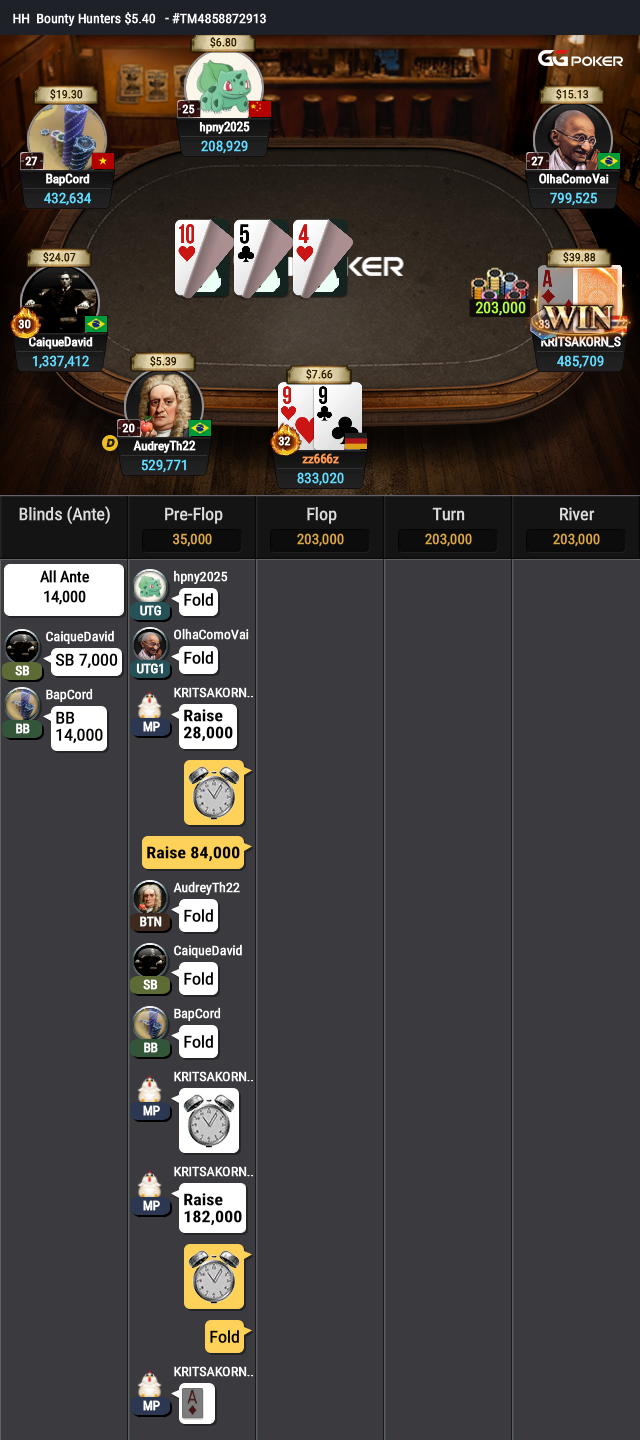
we're 2nd in chips in this 5$ bounty tournament on the final table 7handed with around 66bigs. biggest bounty player to our right with around 40bigs and a 40$ bounty opens.
we have 99 in the cutoff as the covering stack. what do we do?
I choose to 3bet him IP to get more chips into the pot, isolate him, and potentially get him allin. the plan is to call him off if he reshoves, as I expect to see AK / AQ oftenly there.
unexpectedly he 4bets our 84k 3bet to 182k. I end up timing out and folding.
our opponent did not seem to be a thoughtless fishy player. he might be reggish or at least somewhat considerate. in an earlier hand on the final table I bluffcatched him succesfully on the river.
so what's going on here, in his mind?
we assume he knows about a) his big bounty b) me covering him c) me 3bet isolating him because I want to win his bounty
during the hand I ended up thinking that he's not going to ever bluff me for these reasons with something like Ax suited or KQoff as what folds does he expect? I just have to call IP after I already signalled my willingness to play against him or reshove immediately so his bluffs appeared to not achieve anything.
I expect AK and AQ to 4betshove. So does he have only nutted hands there, AA, KK, ...?
only much later I realised that he may have reason to assume that I 3bet him with my whole range just to isolate him and bloat the pot IP to win his bounty. Then he may have reason to expect some or a lot of fold equity to his 4bet immediately and / or postflop. this means he may have bluffs like suited aces in his range.
he showed me an ace when I folded, by your experience, what does showing an ace in a spot like this most likely mean?
another thought I later had was to just call his 4bet and go postflop IP setmining which may be good play even under the assumption that he only has nutted hands like AA and KK there and considering his shallow stack depth.
if he has a very strong hand and we hit our 9 we stack him for some implied odds. and we win his big bounty. as we're IP, we may even get to see the river cheaply if he chooses to play some tricky / deceiving lines postflop, like a small cbet and check on turn. he's shallow stacked, so he'll always be able to get his chips in by the river if he wants to.
even better if he also has bluffs in his range.
edit: in the initial post is a typo, it's bet-call flop, check-call turn and check-call river. hero is oop.
@swedishnit
how do you think opp will play JJ, QQ, KK, AA pre, given big blinds bounty? big blinds stack is 50 bigs, is it too large to influence opp's decision? what stack size would bring decisive strategic adjustments?
regards value betting the river as opp, I saw him betting JJ+ as pure exploitative play against some average calling station on this level. when I thought about his sizing, I would have chosen 25% - 33% on the river though (and he may too if he chose to bet his overpairs), and then folded against a raise.
I would rather check-call flop now.
against his big river sizing we may have folded since it's hardly ever bluffs but oftenly nutted hands or thin exploitative value.
since big blind is rather deep stacked too opp would have less incentive to slow play JJ+ pre. so he actually may have rarely overpairs there.
If we check-call flop, we may get value from barelling broadway bluffs or underpairs or weaker hands than our Aces. on the river we can decide, and maybe it's not for our stack.
because of BB's bounty I thought he may have overpairs, maybe AT off and T9s. after the tournament when reviewing the hand, I wondered if he'd gone for another river sizing with them (or just checked back). I think it wasn't obvious if I was on the fishy side who may call off with a T.
I saw that he's likely not going to have any bluffs there, but overpairs or AT, T9s seemed reasonable. I block flushes too.
Check-call flop is likely better.
The following hand is from a 5$ 500 players bounty tournament on GG Poker. Hero is dealt Aces five handed on the final table with an ace of clubs. cutoff who is a reggish brazil player calls pre.
three clubs are dealt two-handed on the monotone flop:
Tc9c5c
Hero has around 50 bigs and brazil is the table covering chipleader with around 100 bigs.
In this hand, the big blind has the biggest bounty on the table with 43$ and a 50 big blind stack. 1st place payout is around 150$ without bounties.
hero ends up check-calling a raise on the flop, check-calling turn and check-calling a potsize river all-in. hero's bounty is smallish with 7$.
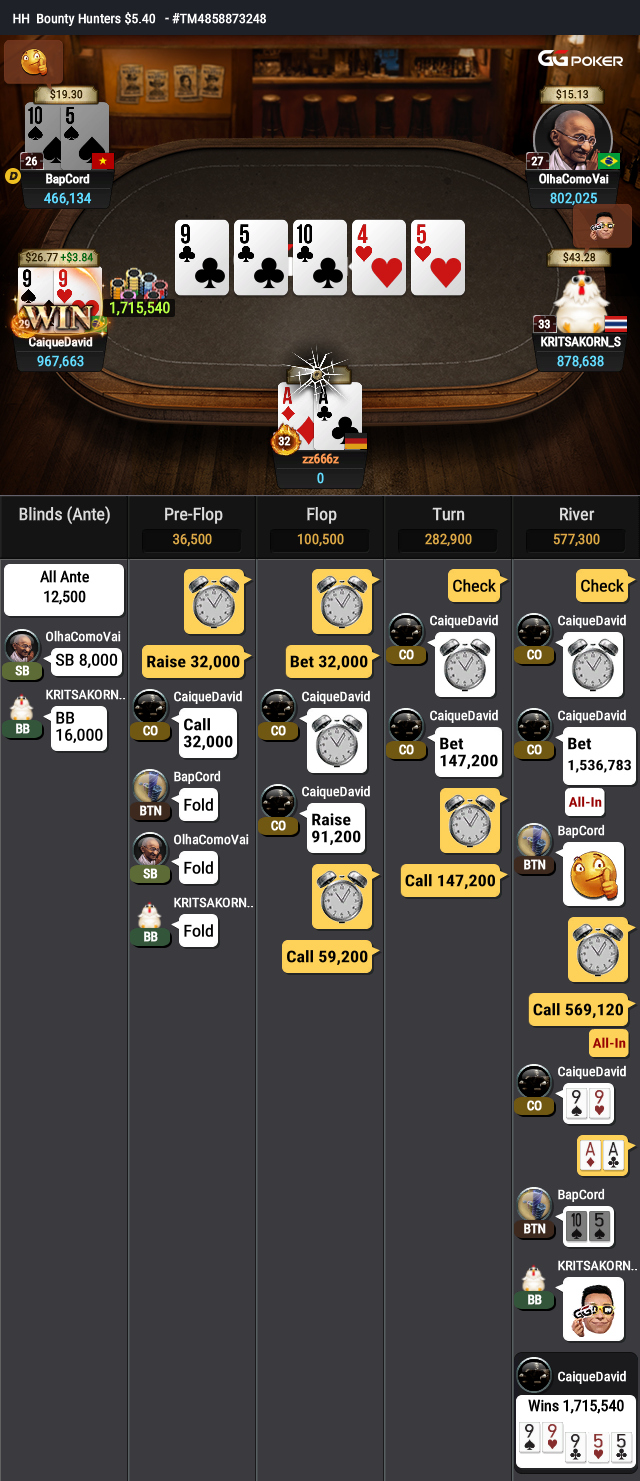
what is the optimal play here?