suntauri

suntauri
archangelAbout
math magicianoh, you said "wow, do you really have two pair?"
that can show disbelief, so you've appeared to be leaning toward a call, I guess?
then it's the other way around, he wanted to induce doubt into your mind, but to make you fold instead.
Hey bro,
Since you've been leaning toward a fold when you said you've top pair and asked villain if he really had two pair,
Villain stayed still to not give anything away and support your inclination while thinking how to react. He came up with the thought to induce a little doubt into your mind with his reply
"that's a tough decision".
He will have had confidence behind his words, it was a feint to make you secondguess
oh I just realised Ive completely forgotten T9s, T8s and TT in his range, sorry for that.
so villain will have a few more value combos that oftenly play this way (except for sometimes checking flop) that are ahead of us.
Im sure there must be a precise and unique way to read and interpret his live tell
"that's a tough decision"
maybe someone will read this and let us know
until then Ill see if I can come up with something
( and his other tell of "no reply" may have also some specific meaning in this context, though probably no unique one in general )
UTG is very unlikely to bluff here vs cutoff and you when QJ got there. Both of you can still have some kings on the river. cutoff may have deceivingly checked back a king on turn to later get value from weaker pairs. You may have checked a king on river to induce a bluff (though that's less likely). At least one of you will have at least a pair, so he'll kind of have to rely on you not bluffcatching him when he went into the betcheckbet line where the second check excludes many strong hands from his range. so I feel like bluffing wouldn't appear as the best idea to him.
He likely has value, which will oftenly be KT which he slowed down with before because of kicker issues vs two callers on flop, but that now became two pair.
He can also have QJ himself.
Best case it's KJ, but I think it oftenly keeps barelling on turn and if not for some reason, then oftenly also bets less on river, since he'll be targeting weaker holdings after all. It wouldn't really make sense for him to slow down with KJ on turn and then when QJ gets there he suddenly bombs pot again.
He'll def have KTs in his preflop range and maybe KToff. So on the river his range will be something along
hands that beat you: {QJ(50%), KT(25%)}: 12 combos
hands you beat: {KJ(10%)}: 1.6 combos
The frequencies are estimated based on above combined reasoning.
Since he bets around pot on river you'd need 33% equity but you have 12%. Thus it's a fold.
toy game != real poker game
strategy in toy game != strategy in real poker game
it's a model game similar to real poker that serves one purpose, that is to illustrate the existence of an intersection point (that is determined by softness of field and edge on field) where one's optimal strategy lies in passing on +EV spots up to a certain degree.
in real poker the spots one would want to pass on in above sense will be rather marginal +EV spots.
Actually it's a triple switch, so it's not only the remarkability of the 997 flop in itself,
but moreover that villain outflopped JJ that was ahead before:
preflop - flop - turn - river
JJ - 97 - JJ - 97
Hero as the observer left out and alienated in the cold struggles to comprehend if it was a bad beat, occult sorcery, a gift from santa or quantum entanglement in a superior dimension
"It was... I don't know what it was"
Turn J gave villain with JJ the nuthouse, so there's remarkability to be accounted for in the double switch of the winning hand from flop to turn to river: 97 to JJ to 97,
AK watching from the sidelines in awe, wondering what the blockers are good for, when villain no 2 was void of any hope and the river revealed his long forgotten, last and only out: the final nine.
Hey guys in this tournament I had 8 chips and finished 3rd.
Unfortunately the highstakes reg who played too came into the final table as slight chipleader above me and was able to choose the seat exactly to my left with position on me.
we ended up playing a few blind vs blind spots.
Im quite unknowing when it comes to blind vs blind battles and would love to hear your comments on my plays
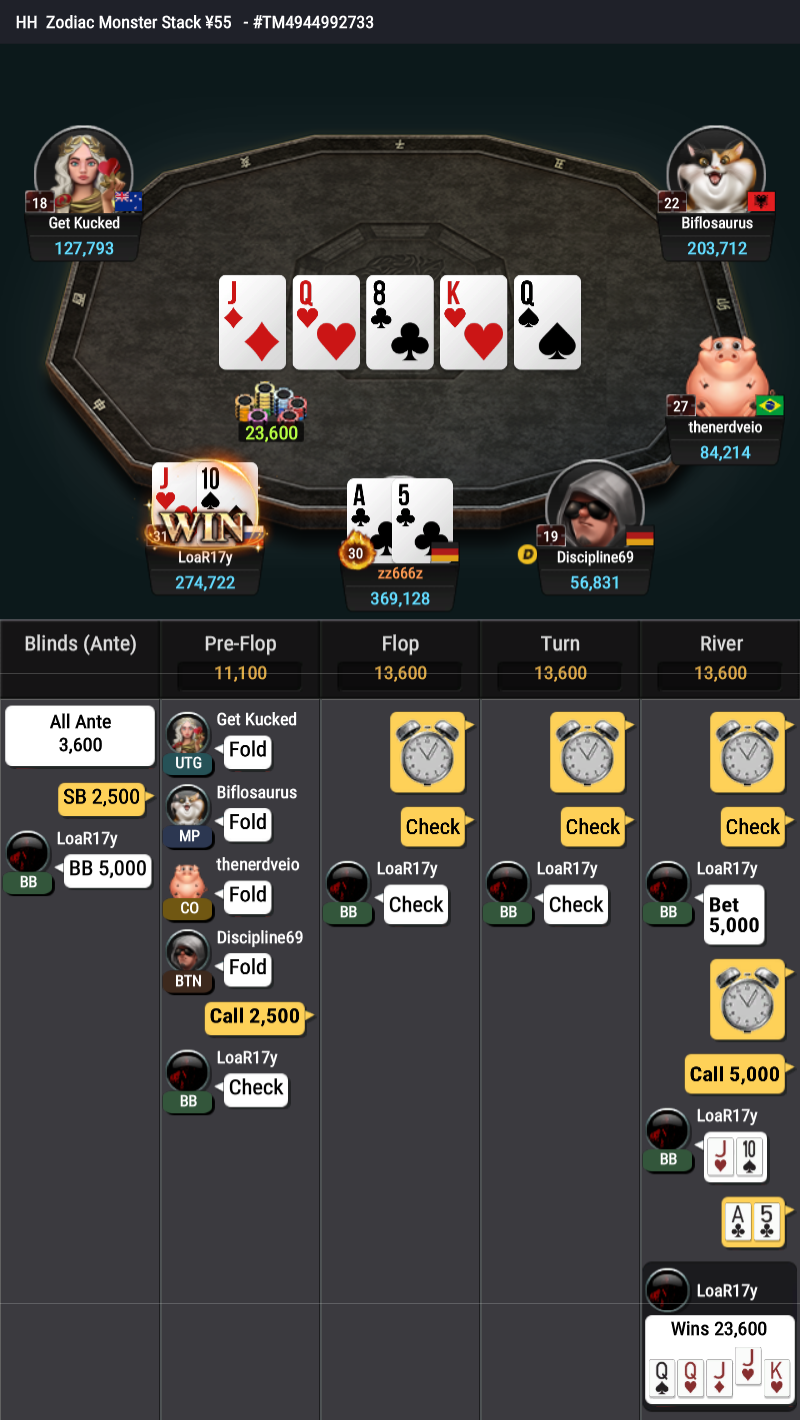
preflop? river call?
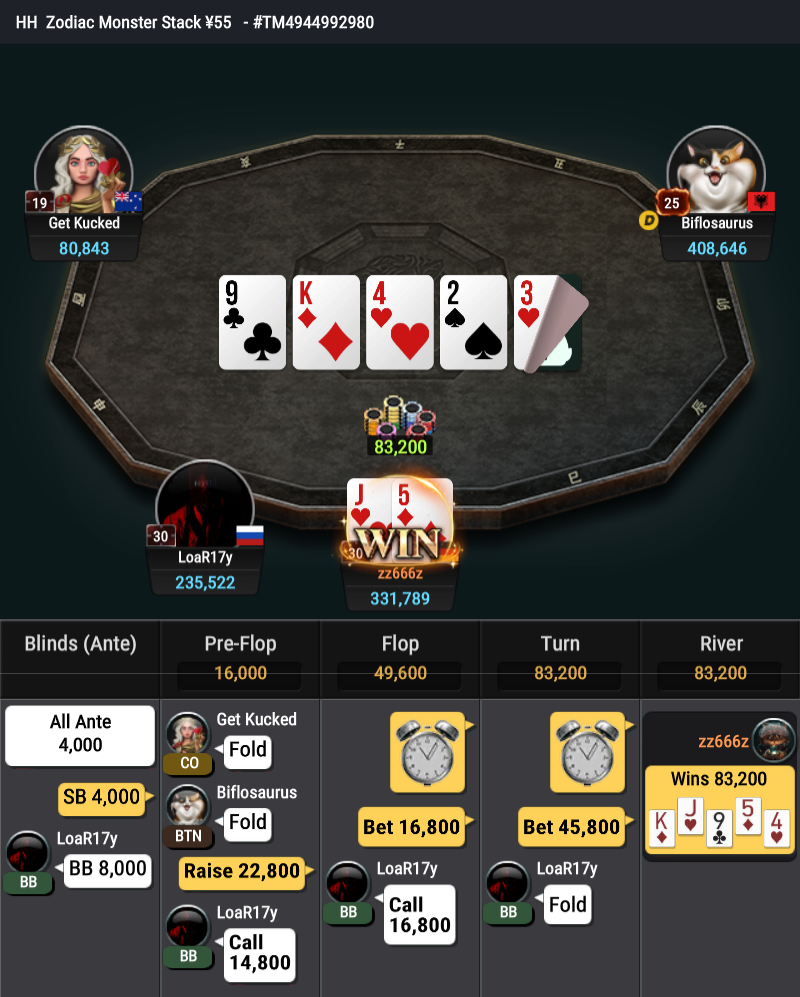
preflop? barrel postflop?
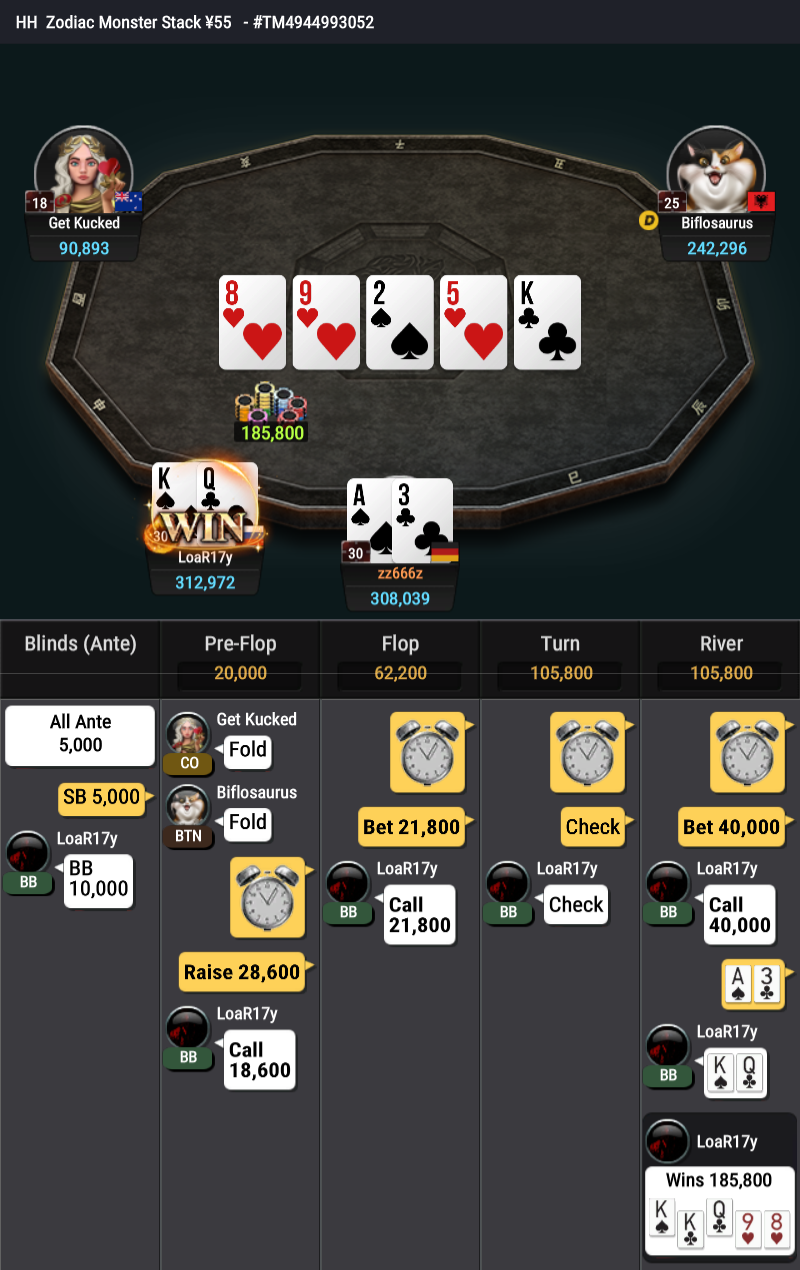
preflop? bluff river?
agree that when determining villain's jamming range bubble's wildness with his 3bets will be crucial.
why would you like to sometimes flatcall vs a solverguy?
Looks like live opponents would love to be very loose in this spot on average by your story of them tankfolding when there is nothing to tank about?
it's a theoretical consideration that basically infers "many nice spots" -> "you'll win more and make more deep runs if you pass on the worst of the +EV" spots and "few nice spots" -> "if you pass on the worst +EV spots now, you'll end up winning less and make fewer deep runs"
it doesn't make any claims about what's realistically achievable in the real poker game now, one has to use his own intuition and experience and estimate where the intersection point lies.
I think you mean different persons in different sections, who of us ranged him on AA (KK)?
it's a toy game to refute greatwhitefish' thought "passing on +EV spots will lead to fewer deep runs and more mincashes"
what numbers?
0.8*0.8 = 0.64, 1-0.64 = 0.36
0.8*0.55 = 0.44, 1-0.44 = 0.56
the numbers aren't important, it's just to show the general correlation
@greatwhitefish
extremely simplified, ***toy game***
say you get 2 spots per blind level where in one of them you can get it in as 80% favourite and in the second one as 55% favourite for your whole stack (and the rest of the spots will be -EV spots).
now you have the option to choose which spots to play, when one blind level lasts for one orbit.
let's compare two scenarios:
a) you choose to play only the 80% equity spots
result: once per orbit you double up with 80% probability and bust with 20% probability, and pay blinds and antes.
b) you play all +EV spots
result: once per orbit you quadruple up with 44% probability and bust with 56% probability, and pay blinds and antes.
now back to scenario a) for another orbit:
we take another 80% spot, and after two orbits we (almost, besides relatively negligible blind impact) quadruple up with 64% probablity and bust with 36% probablity, and pay (blinds and antes)x2.
we begin to see that one difference in strategies a) and b) will be the theoretical time we need to chip up and potentially win all the chips, but as long by paying doubled blinds and antes doesn't outweigh the equity gain of our strategy we wont feel in any hurry as nothing else is gonna rush us.
in strategy a), we keep our chances of busting with each multiplication of our stack lower.
but not only that, we also increase our chances of making a deep run and winning.
lets assume, simplified, that we need to quadruple up to win all the chips in play and the tournament.
then our chances of winning are (simplified besides negligible blind impact) 64% in strategy a) and 44% in strategy b).
similarly the chances of deep runs will differ and be greater in strategy a) than strategy b).
when does strategy a), in a broader sense, begin to fail?
that's when paying doubled, continuously increasing, blinds and antes every orbit begins to outweigh the equity gain of strategy a) over strategy b),
so when for example the equity for best available spots drops from 80% to 56%,
the cost of paying doubled blinds and antes will outweigh the equity gain from passing on marginal +EV spots that we had before and our winning chances and chances of making a deep run will drop.
fewer high equity spots will also contribute to that.
all of that amounts to the following conclusion:
we can make more deep runs and get more wins with a strategy that passes on +EV spots,
but if there are not enough "nice" spots for us to take we may have to pay a high price and end up winning less.
altogether, big enough edge makes passing on marginal +EV spots theoretically optimal strategy and does not reduce your chances of making a deep run.
out of curiosity, how would you play your strongest hands pre as villain here?
In this live tourney, Id see it like that.
We got to take care of how we categorize someone as aggressive. aggressive != aggressive.
Villain was aggressive in a certain way with his 3bets, that he may feel comfortable with to outplay his weakish opponents in a soft field.
We should not generalize too fast that he'll moreover be aggressive in every other possible way.
We may even find ourselves being counterexploited if he looks down at his aces and in a flash of inspiration thinks "oh, Ive such an aggressive image right now, let's take advantage of it and fastplay my aces like I would some other weaker premium" when he usually may trap with a flatcall or go for a 4bet.
normally Id assume that stronger premiums like AA and KK will find themselves in slower played lines at a higher frequency than QQ and so on, but here you already reraised to 18 bigs after he raised to 5 bigs, so it's more like a normal 4bet size that you put into the pot. Thus our situation is not comparable with a classical 3betpot and all his premiums will rather be expected to be jams.
regards his jamming range overall, it's just gonna be AA KK QQ so often here that I agree with you. He will send AK into a jam at a lower frequency in this live tourney. He may also not want like you to take marginal chipEV spots with higher variance when he can comfortably exploit the soft field with postflop play and identify growing noses instead of potentially flipping for his stack in a preflop allin.
There's much more motivation for you two guys to take only cherry on the cake spots and maybe also avoid exposing yourself to higher variance spots.
even if his range was AA KK QQ JJ AK which I think is wider than his real AA KK QQ(75%) AK(50%) JJ(25%) range,
you'd have 40% equity when in chipEV you need 36% equity, and live that's just not enough.
if he's opening 10% or 30% does change things a little bit, but a player who's opening 10% will unlikely be of the kind who's gonna go for yolo bluffs postflop, thus he'll likely be strong. if he's opening wide, he'll have a lot of JT, 9x and so on, maaany strong hands.
let's just assume he's an avg opponent in these lowstakes, and we'll be somewhat covering all cases already.
1) would he bluff into you?
you have a lot of 9x, JTs, Kx (KJ, KT, ... ) that called flop and usually also turn in your range on the river.
into such a strong range, when weaker holdings make up much less of it, one doesn't want to bluff into.
(in vacuum much fewer bluffs have to be expected here too since you started out 3way on the flop, and he's playing vs you in the cutoff, not the big who can have much more weakish hands)
2) would he valuebet weaker hands into you?
he goes for pot on the river, if he had a one paired king type of hand that you beat he'd want to target something like a queen, and then he'd never go for pot in this spot.
simple fold he's always better
yeah TT is a jam.
if players have badges I usually give them more credit.
if he called you with A5off we'd be slowly getting into punt territory. A9off is slightly off.
with a bigger stack he'd have to take more care, since he'd be potentially risking more than 10 bigs if someone behind him wakes up with a strong hand.
it's a bit too loose. if it's on gg, gg stats don't show profit, but winnings. It can be an indicator of experience, but not necessarily skill.
regards the spot, not only your stack matters, but also the stacks of the other players.
if villain has 50 bigs and everyone else too, it's different than if he has 10 bigs himself.