Introduction to Small Stakes No-Limit Hold ’em: Help Them Give You Their Money

Hi Everyone:
Here's part of the Introduction to or upcoming book
GTO will win in low stakes games. But it's comically sub optimal. The entire strategy is based on not being exploited in a player pool where 99 percent of players aren't trying to exploit you.
1000 times this.
As a dealer and a player in low level games it is still quite common to have a player make a large bet on a 4 flush or 4 straight board and his oppent think a while and call. Then the large bettor takes the pot with the inevitable flush or straight. Then while the next hand plays out the losing player will mumble something about not seeing the flush or straight.
Playing GTO in these situations will win, but it is ridiculously suboptimal. An old school framework is far better. Many of your opponents in these games are using nothing more than 1st level thinking.
Even when they use 2nd (or higher level) thinking they do it poorly.
The other day I was dealing a $1/$3 game and it was the usual limpfest. One hand there was a bunch of limps and a late position player (who wasn't very good) raised to $15. Button calls. Action gets to the small blind who I know is a very good player. Very good.
He thinks for a long time and then shoves. He has everyone else at the table covered. Most other players have $300-$500.
Each of the limpers takes a long time but eventually fold. They really want to call. All of them. Eventually it gets back to the initial raiser. He thinks for a long time, then he starts talking about what the small blind shove could have. I stop him (the button is still in the hand). But he had said stuff like "that bet is so large you must have pocket eights and do not want to see a flop".
Eventually the initial raiser calls for his stack. The button then starts thinking. He really wants to call but finds a fold. He shows pocket nines as he discards them.
Small blind then turns over his aces and the initial late raiser sighs and turns over KJ offsuit. He called with KJ offsuit to put about $400 into a pot that barely had $50 in it.
Why is a player trying to avoid being exploited at this table? At most of these low level games GTO is a joke. I get that proper GTO includes exploitative play, but is it really GTO if you are exploiting 90%+ of the time?
So basically the authors don’t have any training in poker gto and are lying or delusional when they make claims about gto
You can’t discuss or compare something you know nothing about, certainly not on a paid and published level. I mean you can discuss it, but what you say has no validity besides guesswork
I am often one of the last people to defend Mason and Sklansky on these forums, but to be fair to them they were using GTO concepts long before there was anything anyone would remotely call GTO.
I think it is silly to say that they don't have any training in GTO.


There may be some GTO concepts which are useful in 1/3 NL. For example, you don't want to cbet so much on boards that favor the caller or when OOP and you can make large or small sizings, not standard percent of pot.
The book mentions an example where you raise with A5s and the solver recommends sometimes making a 4-bet. At low stakes, the 3-bettor probably has QQ+. AK or tighter, so the 4-bet bluff would be really bad. You obviously don't want to make GTO recommended small preflop raise sizes. Making 1/3 pot range bets on the flop generally really bad, particularly in 4-way or whatever pots. You can't apply GTO directly, as GTO does not deal with 4-way + pots and doesn't understand loose-passive play. You should play small pps in most situations, because you are likely to get multiway pots and opponents will pay off sets. You also want to play suited aces, mainly to stack someone with set over set.
I am not an expert at GTO, but understand some basics. I haven't actually used a solver. I find some of the RIO etc. videos where they spend 30 minutes going over a hand with solver charts in the background tedious and not helpful. There are other videos with like 10 things we have learned from solvers which seem more useful. I also feel that some videos go overboard on taking a GTO approach, worrying about what we block and unblock, when that information should only be used in very borderline cases. Sometimes, it seems like video authors are afraid to discuss things not in terms on GTO, for fear of being branded old school.
It becomes more important the higher the stakes. If someone wrote a book on how to beat 5/10 NL and didn't understand GTO that would be an issue. Maybe important online, but I would not play online today for various reasons. Bart Hanson has free videos going over 2/5 NL hands, some 1/3 and some 5/`0 or bigger. Those videos often discuss GTO concepts as part of practical mid stakes play.
I don't agree that the authors knew about GTO before it became such a thing being too relevant. There is a lot of recent information from solvers that understand game theory etc. does not help with.
I guess Pointless went away when I pressed him on whether he read the book. It would be more helpful to discuss specific disagreements with the book and specific ways GTO should be applied to low stakes live play.

Your interchanging solver output with GTO. They're not the same thing. No one knows what the GTO strategy is to NL poker, but the GTO strategy doesn't change based on the strategies of the players. Solvers are a tool we use to try and come close to what the GTO strategy is. But solvers can also be used to find exploitable strategies based on assumptions.GTO is not exploitable b
Actually, I would think it's still (trying to) play GTO after it node locks. If you have your opponent always folding aces, the computer will play the best GTO strategy against that proclivity by itself, which means that the computer will assume that the other guy is asking his own solver to come up with the best GTO strategy when it can't play aces (perhaps due to a proposition bet). What your solver WON'T do is assume that if this guy is stupid enough to fold aces there are probably a lot of other things he is doing wrong.
1000 times this.As a dealer and a player in low level games it is still quite common to have a player make a large bet on a 4 flush or 4 straight board and his oppent think a while and call. Then the large bettor takes the pot with the inevitable flush or straight. Then while the next hand plays out the losing player will mumble something about not seeing the flush or straight.
We have discussion of this exact play in the book. See the chapter "Consider Huge Reraises with Those Top Four Hands."
Mason

Actually, I would think it's still (trying to) play GTO after it node locks. If you have your opponent always folding aces, the computer will play the best GTO strategy against that proclivity by itself, which means that the computer will assume that the other guy is asking his own solver to come up with the best GTO strategy when it can't play aces (perhaps due to a propositio
The solver is looking for the Nash Equilibrium based on the inputs. That's different than the GTO solve for the game as a whole, which is based on the rules of the game and known facts (stack sizes, which player is in position, etc.). It's sort of like GTO, in that it's optimal for the assumptions, but it's based on assumptions which could be, and almost certainly are to some point, wrong. Thus, that solution can be exploited. The GTO solution can never be exploited. In practice, you never know what you're opponent will do, and even if you guess right, he might change the way he plays in the future, foiling your solver solution. In the example you cite, if it was a rule that aces always must fold, then the solver solution would approach a GTO solution for the aces-must-fold game, based on the limitations of the solver. But in the aces-must-fold game, folding aces isn't an assumption, it's a rule.
I’ve beaten 1/3 2/5 many thousands of hours per stake. Nice try. I don’t care what you believe.
I don’t see how you can criticize something you know admittedly close to nothing about which is the same issue I take with the authors/ the book.
I doubt it. The only thing you've beaten is a dead horse with your nonsense. And I have a lot of experience with people like you who exaggerate their credentials and knowledge.
I’ll leave you guys be. I’ve made my point already and enough times
Good riddance.
I have gotten good GTO information from the free Upswing videos and the free version of Simple GTO trainer. Unless you are playing high stakes or online, I think you are wasting your money paying for anything on GTO. I used to have RIO Elite, but mostly watched the PLO and mixed games videos. I don't care for holdem much, and found the RIO NLHE videos with the solver charts tiresome.
No it wouldn't lmao. They're just hustling to sell courses to 20 year old weekend warriors and GTO heroes playing low stakes NLHE.
Well first Berkey hates GTO and admits to being a feel player. It would be impossible test as nobody is gonna let anyone saddle up to the table and run GTO wizard. I do think a str8 GTO strat would destroy a live low stakes game. It would make a money every time the other players made mistakes and low stakes live players are horrible and make lots of mistakes

Well first Berkey hates GTO and admits to being a feel player. It would be impossible test as nobody is gonna let anyone saddle up to the table and run GTO wizard. I do think a str8 GTO strat would destroy a live low stakes game. It would make a money every time the other players made mistakes and low stakes live players are horrible and make lots of mistakes
One way to find out. Bring your laptop and play according to the outputs.
Well first Berkey hates GTO and admits to being a feel player. It would be impossible test as nobody is gonna let anyone saddle up to the table and run GTO wizard. I do think a str8 GTO strat would destroy a live low stakes game. It would make a money every time the other players made mistakes and low stakes live players are horrible and make lots of mistakes
How do you know what GTO is for 5-way pots? You won't get that from a solver. Then can you beat them at a decent hourly rate after rake and tips?
How do you know what GTO is for 5-way pots? You won't get that from a solver. Then can you beat them at a decent hourly rate after rake and tips?
Do 5 way solvers not exist? I know about simple 3way but i assumed someone would have invented a 4+ way solver by now. If not then yea that's a bit of an issue
Actually, I would think it's still (trying to) play GTO after it node locks. If you have your opponent always folding aces, the computer will play the best GTO strategy against that proclivity by itself, which means that the computer will assume that the other guy is asking his own solver to come up with the best GTO strategy when it can't play aces (perhaps due to a propositio
The solver is looking for the Nash Equilibrium based on the inputs. That's different than the GTO solve for the game as a whole, which is based on the rules of the game and known facts (stack sizes, which player is in position, etc.). It's sort of like GTO, in that it's optimal for the assumptions, but it's based on assumptions which could be, and almost certainly are to some p
I just read the introduction to the book where Sklansky states in part, "However some computers are programed to alter their usual tactics if you input specific tendencies of the opponents. And they'll do better than GTO tactics if the inputs are accurate. . ." That is pretty much demonstrates he already knew the point I way trying to make. Perhaps he thought I didn't know what the solver was trying to do. We're (all poker players) getting into discussions on what we mean because we're using the term GTO differently. It would be great if everyone in the poker community used the term in the same way. Are we talking some kind of static thing independent of player tendencies (like I think), or a way of thinking, or simply balancing based on known or assumed tendencies, or solver outputs?
Do 5 way solvers not exist? I know about simple 3way but i assumed someone would have invented a 4+ way solver by now. If not then yea that's a bit of an issue
Pluribus is a bot that played 6-way against live professional players, and supposedly beat them over 10,000 hands. An analysis by another party suggests it lost. There were two types of matches, Pluribus vs 5 live players (10,000 hands), and one live player vs 5 times Pluribus (against two different pro opponents, 5000 hands each).
https://en.wikipedia.org/wiki/Pluribus_(...)
http://kevinwang.us/lets-analyze-pluribu...
https://www.science.org/doi/10.1126/scie...
Pluribus isn't a solver in a sense that you can input ranges into it and it isn't available to the public. But obviously the game was "solved" to some degree in order for it to play the game and beat the professional players. It didn't adjust for player tendencies. There are YouTube videos showing the specific hands.
I just read the introduction to the book where Sklansky states in part, "However some computers are programed to alter their usual tactics if you input specific tendencies of the opponents. And they'll do better than GTO tactics if the inputs are accurate. . ." That is pretty much demonstrates he already knew the point I way trying to make. Perhaps he thought I didn't know what
My statement in the book is sort of technically wrong as well. What I am trying to say is that if you tell the perfect GTO computer that it should assume that an opponent plays a certain hand in a non GTO way, it will exploit his play via the GTO strategy that would now apply if the locked tactic of the opponent was part of the rules of the game.

Example No. 1: Here’s a hand that David played in a Las Vegas $1-$3 game. It’s an extreme example, but we want to start with it to show how different many of the strategies in this book are and to give you an idea of how different, in some situations, our approach to maximizing your expectation is from the typical player, and this includes most of those who are currently having
Can you remind me which chapter the reasoning of this is explained regarding the J97 flop?
The general reasons are covered in several places. Namely beware of having few outs, beware of opponents whose bets are usually, but not always, with hands that beat you or are favored over you, and beware of situations where there are more rounds of betting to come, and you can't get all in early. In this particular case it would have been right to call or possibly make a small raise on the flop if the opponents are timid and straightforward. If they are the opposite, I am almost positive it is a fold. But not to the point that I would enshrine this particular recommendation or the precise reasoning in the book. The hand was mentioned mainly to illustrate how unusually some hands should sometimes be played. Sorry that the introduction (which was written before most of the main text) might have given a different impression.
I don't hate the flop fold. Low stakes players are generally passive so when one bets with multiple players left the act they likely have a jack at worst. Kings are in good shape against a jack but that's the bottom of their value range. It's the flat pre that I hate. I assume David was going for a Craise but you can't count on these players to raise at least not in general. Now if he was wanting to play a multiway pot then i have no idea what he was thinking. Also I would call flop unless it's raised before it gets to me.
The general reasons are covered in several places. Namely beware of having few outs, beware of opponents whose bets are usually, but not always, with hands that beat you or are favored over you, and beware of situations where there are more rounds of betting to come, and you can't get all in early. In this particular case it would have been right to call or possibly make a smal
Thanks, this elaboration makes sense.
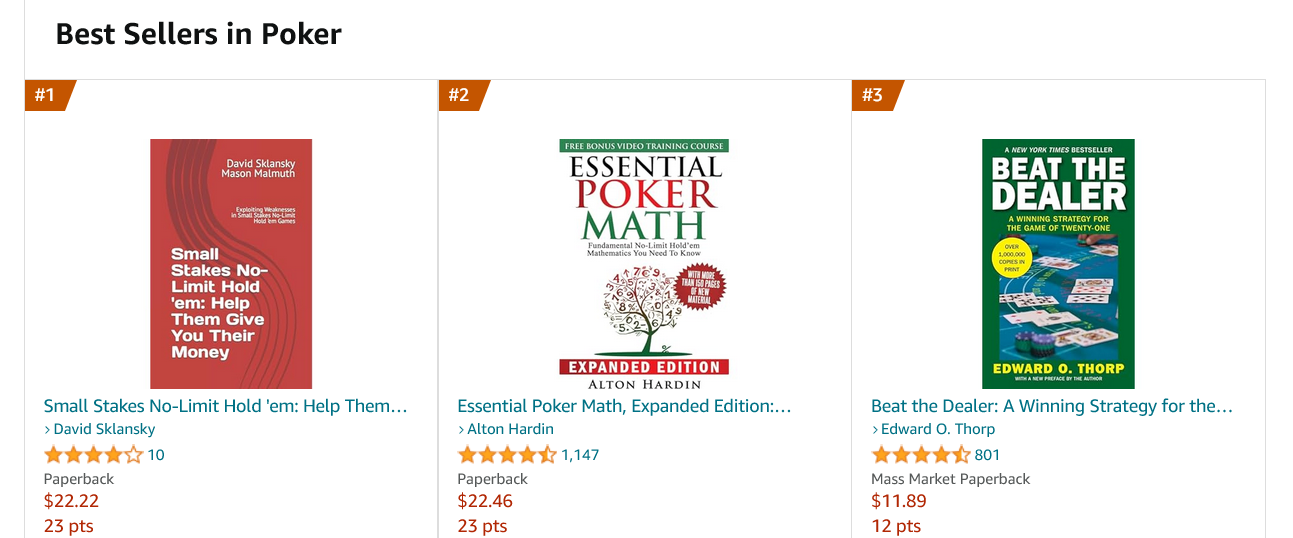
While it's taken a couple of months to do so, this book is now #1 on the Amazon Best Sellers in Poker list:
https://www.amazon.com/gp/bestsellers/bo...
Thanks to everyone who bought a copy.
Mason
While it's taken a couple of months to do so, this book is now #1 on the Amazon Best Sellers in Poker list:
https://www.amazon.com/gp/bestsellers/bo...
Thanks to everyone who bought a copy.
Mason