Introduction to Small Stakes No-Limit Hold ’em: Help Them Give You Their Money

Hi Everyone:
Here's part of the Introduction to or upcoming book
Minimize your opponents max expectation sounds like “lose the least” to me.
Your opponents expectation is how much you lose
Minimizing how much you lose=trying to lose the least imo
Like I say, you have very little understanding of how GTO poker actually works. Also, you left out the other side of the maximin principle which is to maximize your minimum expectation.
This stuff is all on the Internet, you should spend some time reading it as well as the other references I suggested.

Could be!

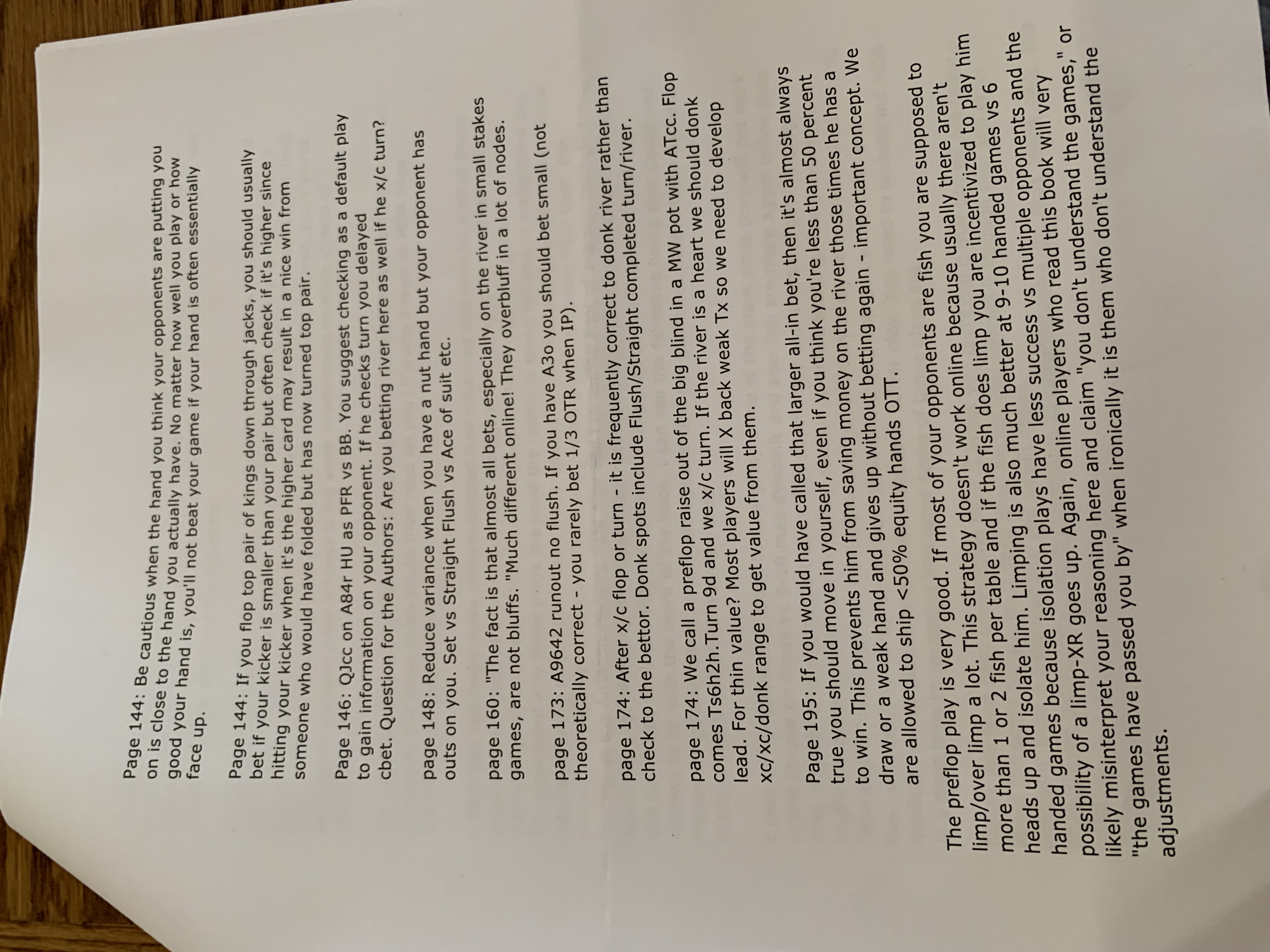
I'm going to copy/paste my notes on this book and give my review at the end. 1. Limping first in - important.1A. Buying in for the minimum to have an advantage over larger stacks!1B. In a typical $1/$2 live game - we should be opening $6 preflop as a default! 2. Short term tilt is an important concept
hey man thank you for your writeup I appreciate it!
Going by memory, I don't think it says anything like this. Perhaps you can find the place and I'll take a look.On page 62 it says:
thank you, ive been hammering the preflop sections and reading it so I will continue to re read before moving forward imsre i havent gotten to the 3 bet or raising sections and to be honest, I prolly am a poor reader and haven't read as much as I am still in the first 50-60 pages
I appreciate your thoughts on the matter and so far think it is a really eye opening book and one that made me think very differently to expand my knowledge

IMO, the ideas in the book are really good. Some of the specifics are weird, and sort of limit player style. For example, raising to 6 in 1/2 is sort of ridiculous, when people will treat a raise to 10 about the same as a raise to 6. If you raise to 6, you will probably get a significant percentage of 3!s, which are rare against a normal raise size.
Similarly, talk of mid-betting and doubling the limped bet to build the pot are limit poker style. You can bet small or raise small at limps, bit mid bets look just ridiculous in NL.
People tend to bet about pot in 1/2 and 1/3 in limped pot. I couldn't limp behind on the button with 87o or Q6s or whatever and find enough situations I could continue on postflop.
Making buying in for the minimum, making raise sizes that most limper will call and sometimes playing for a limp/3! seem really sound at low stakes, although not what is usually advised.
IMO, the ideas in the book are really good. Some of the specifics are weird, and sort of limit player style. For example, raising to 6 in 1/2 is sort of ridiculous, when people will treat a raise to 10 about the same as a raise to 6. If you raise to 6, you will probably get a significant percentage of 3!s, which are rare against a normal raise size.Similarly, talk of mid-bettin
i think from what i gathered from them is that we are going to maker FAR FAR less mistakes than opponents post flop so building pots small and surely so when big hands develop we maxmize
i think from what i gathered from them is that we are going to maker FAR FAR less mistakes than opponents post flop so building pots small and surely so when big hands develop we maxmize
Yeah, the ideas are good and sometimes original. However, I wouldn't take it as a manual and literally play the sizings, hand ranges, etc. they suggest.
The ideas are really good, but some of the specifics are questionable.
Sorry not using 2+2 Publishing x off the button. For example, in a 1/3 game, LJ and HJ limp and I limp behind in CO with A3s, BB checks, 4 to the flop. Flop comes T87 giving me a flush draw. LJ bets 25 into 12, HJ calls and I call. Turn is an offsuit 2 and it is checked around. River is a 5, giving me the nut flush. MP leads for 60, I raise to 160 and he calls. Someone asks him how high his flush was and he says he didn't see the flush, and had top 2 pair.
So the point is a lot of these limped pots become really big and you can make a big profit with little investment. Just out the $3 when you miss. Sometimes this is a better way to play speculative hands like Axs and small pps. With like ATo, KJo, why drive out hands like dominate. You can limp/fold those hands. You can limp/call small pps from ep.
I wouldn't limp as much as the authors seem to suggest. However, the rule about never limping is EV- at low stakes.
The ideas are really good, but some of the specifics are questionable.Sorry not using 2+2 Publishing x off the button. For example, in a 1/3 game, LJ and HJ limp and I limp behind in CO with A3s, BB checks, 4 to the flop. Flop comes T87 giving me a flush draw. LJ bets 25 into 12, HJ calls and I call. Turn is an offsuit 2 and it is checked around. River is a 5, giving me the nut
You're out $3 if you whiff the flop and fold. In your HH you would be out $28 if the river bricked. The turn got checked around on a brick which is lucky otherwise with a river brick you're out ever more.
MP lead the river. Was that the LJ, who lead the flop, or the HJ who called flop? Based on who it was, you would range them differently and adjust your raise size. To add to your point; one hand in isolation doesn't determine if limping (or any other play suggested) is correct. That's the overall problem with the book.
Yes that is what's generally thought.
There aren't any significant exceptions in my mind. Maybe some weird situation with a promotion.
I do like multiway, as the other players will be worse at multiway than HU, but I wouldn't go to this extreme.
In my very limited experience playing 1-3 NL and only being halfway through the book, it seems that QQ is much closer to JJ than to KK let alone AA.
Interesting stuff... And I haven't read thread,only original posts,showing book content
Don't alot of small stakes games have some,shorter stacks... And if you,start with 50 BB stack, the limp-reraise is generally good.
There,are not tables full of people with zero clue any more.. 2004 it was,like,bingo
I’m just curious, but how do you know the book advocates weak-tight play? You haven’t seen it. Also, one of the authors is also the author of The Theory of Poker.
And by the way, in 1988 I added the term “weak-tight” to our book Hold ‘em Poker for Advanced Players and I’m very sure that was the first time it was put in print.
Mason
The concept, in a completely different context, was mentioned by the high stakes amateur player AJ Myers in The Biggest In Town, published in 1983.
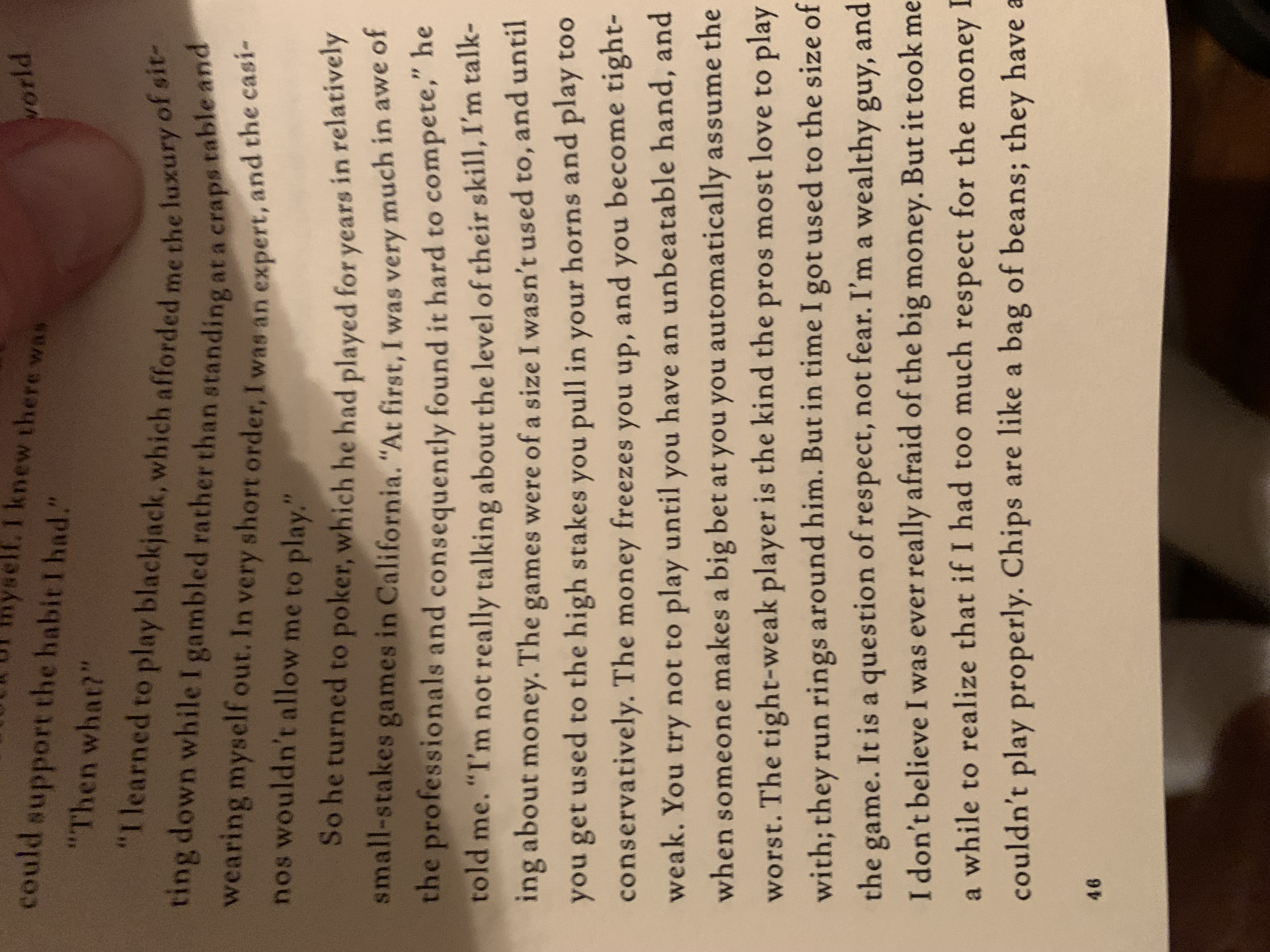
The concept, in a completely different context, was mentioned by the high stakes amateur player AJ Myers in The Biggest In Town, published in 1983.
The term "weak-tight" was not original to me. I first heard it from Ray Zee but believe I'm the first one to use it in print.
By the way, I knew AJ Myers fairly well. He was a regular in the big stud games.
Mason
Yes, thanks! I am almost finished with the book and look forward to rereading it with the notes (which I’ve proofread and lightly edited) while making my own.
Cliffs: I’m the rawest rookie at NLHE. I’m up $486 after 104 hours and it should be at least quadruple that if not for a handful of mistakes mentioned in the book and emphasized in the notes.
Herre’s a song for you DooDoo!

By the way, I knew AJ Myers fairly well. He was a regular in the big stud games.
Mason
Was AJ’s “California Matisse odalisque daughter” as attractive as Alvarez implied she was in the book? 😃
36 is divisible by 18, 12, 9, 6, 4, 3 and 2, all giving even money. The 37th number, the zero, gives money to the house. Yes, the expected losing is constant.
Only a sixth of the way through the thread and it’s delivering as spectacularly as any in the 22 year history of the forum, and I was here on Day One, though I’ve only recently returned from a thirteen year sabbatical.
Never change, 2p2.
I would argue that even playing high stakes poker is not worth it. Anyone intelligent/talented enough to make money at it could make far more money doing something else.
This has been discussed since Biggest Game In Town was excerpted in New Yorker 41 years ago. Probably deserves it’s own thread. Fifty plus years ago that was definitely not the case.
Doyle, Chip & David all famously quit jobs for poker for the usual reasons. I don’t know if Mason has ever discussed his transition in depth.
Bobby Baldwin is probably the only person to ever leverage poker into serious corporate success. Phil has certainly made lots of contacts in the VC world. Stu couldn’t have held a straight job for thirty days for ten million dollars.
The term "weak-tight" was not original to me. I first heard it from Ray Zee but believe I'm the first one to use it in print.
By the way, I knew AJ Myers fairly well. He was a regular in the big stud games.
Mason
OK, so you were the first one to use weak-tight in print, but someone used tight-weak before that.
This has been discussed since Biggest Game In Town was excerpted in New Yorker 41 years ago. Probably deserves it’s own thread. Fifty plus years ago that was definitely not the case.Doyle, Chip & David all famously quit jobs for poker for the usual reasons. I don’t know if Mason has ever discussed his transition in depth.Bobby Baldwin is probably the only person to ever leverag
A lot of my transition was based on the idea that I could successfully write about poker/gambling. It wasn't just to play poker. If that would have been the case, I doubt if I would have left the very good job I had with the Northrop Corporation. So comparing me to some others who left their jobs just to play poker is not a good comparison.
Mason
A lot of my transition was based on the idea that I could successfully write about poker/gambling. It wasn't just to play poker. If that would have been the case, I doubt if I would have left the very good job I had with the Northrop Corporation. So comparing me to some others who left their jobs just to play poker is not a good comparison.
Mason
Hi Mason, thanks for the feedback, I wasnÂ’t meaning to compare you to anyone. Obviously there was a huge untapped market for accurate information regarding gambling & poker, as Beat The Dealer, S/S, and DavidÂ’s first books proved.
David made his reasons for leaving the business world explicitly clear in BGIT.
My main point was that Doyle, Chip & Bobby almost certainly made far more money by the age of 30-40 playing poker than they couldÂ’ve any other legal way back then. This has probably not been the case for the last 30 years at least for a 21yo.
BTW has Dan Harrington ever mused about if heÂ’d been born into a gambling family or in Texas? No reason to believe he wouldnÂ’t have been hugely successful as an olÂ’ road gambler, though IÂ’m sure he has no regrets. Pure example of someone who excelled at everything he focused on.
There are also lots of very high paying technical jobs that do not require soft skills. Especially in this day and age when everything is online and a programmer can read a requirements document listen in on a requirements gathering Zoom recording and barely ever have to talk to someone. Or a QA tester can create and run test scripts whose only output is a database entry of er
Speaking of soft skills or lack thereof, AI will be doing all that within five years if not three.
Sklansky lost $3 in that Kings hand, by the way. There are weak players who would do better if they adopted a small-loss approach for playing QQ.
FYP
In for $200, out for $320 in 3 hours of play. (High watermark of around $450 at one point)I bring this up because-> 150 miles of wear/tear on car @ .72 mile to operate a vehicle according to BTS.gov, gas included = (-$108)-> 2 tolls @ ~(-$8) total-> 2 hours of my time commuting on a weekend-> around (-$10) in tipsI won't even factor in rake.Some say I made $40 an hour playing
Yeah, from 2002-7 I made $10-20K annually with a similar overhead playing 10-20/15-30 LHE w/overs 3+1 rake every weekend. We did get comped rooms/food coupons and the games were VERY enjoyable socially; large group of regulars and semi-regulars. Room was packed during peak hours and located right next to the pit.
After a 17 year exile, still get free room with ten hours play & $2/hr comps; 1-3 games are pretty soft 4+2 rake, room is on the far NW corner mezzanine. Most of the old regulars long gone. Still mostly friendly but the festival atmosphere might as well be like a Woodstock documentary.
$10-20K annual grind likely possible but the thrill is gone. But 4.5 months sober IÂ’m $5K ahead going there than to the local bar.
If youÂ’re good at something, never do it for free.
I didn't bother to respond to his email of a couple of days ago.
I'm also currently working on the rewrite and expansion of my Gambling Theory book, it's over 500 pages. It should be available in a couple of months and I plan on giving the kindle away for free.
Mason
Dang, sorry I missed that, but thanks for this current freebie!
Time for a big stud resurgence, nay, a Resurrection! The $10K final table broadcast was wonderful. I canÂ’t believe people wouldnÂ’t enjoy having their own hand, especially kids whoÂ’ve only played HE.
What helped kill it were those terrible 1-4 1-5 games and dcking around with 50 cent pieces in 5-10. Dollar ante, $2 bringin, first to act completes to $5 would be a goldmine for good players and give the fish some bang for their buck. Overs buttons to ldo. Training dealers would be an issue.
'If you're good at something, never do it for free'
'Thanks for this current freebie!'
Hah
I’m definitely overlimping KK the next time I get it lol.
respectfully disagree about the KK take, exclusively ISOing a tighter range is fine, likely that limping behind with a wider range of hands including some traps is also finedepends on how you play postflop, strictly from a GTO perspective if we were able to solve this spot pre while nodelocking 4 limps, if we donÂ’t get to limp KK with 4 players behind to act it would be a very
Just watched the replay of the $100K final table where KK on the button flopped a set and slowplayed JTo in the blind into a r-r straight and headed to the rail; made me think of thread and lol a bit.
going down that escalator and seeing the Taj poker room to your right and all your friends getting giddy was an awesome thing to watch
Twenty years ago there was a long airport style ‘hallway’ connecting the hotel to the casino. I used to pump myself up with the Walk That Aisle promo while visualizing bands going from dressing room to stage on live DVDs. About 3/4 of the way down I’d hear that first slot WOOOO!
Imagine having a job you liked going to 1/10 that much.
I have some problems with the book, but it didn't suggest slow playing at all.
The overlimp KK play is good in context. You have someone raising 60% of the time when it is limped to him, but maybe 3-betting 10% of the time. If you come in as the 4th limper and 3-bet, it looks like you could be bluffing with a weak hand or trying to build the pot with something like AQ/TT. Anyway, 1/3 players won't fold to 3-bets and have trouble folding top pair etc. It isn't like you should normally overlimp KK.
The way the Introduction was presented here with no explanations for plays based on reads was intended to create interest through controversy, but created too much controversy.
Overlimping KK is a slow play.


